
Signal Library surfaces signals of change from credible research, evidence, news and blogs presenting a curated selection of the latest developments relevant to AI and education in low- and middle-income countries.
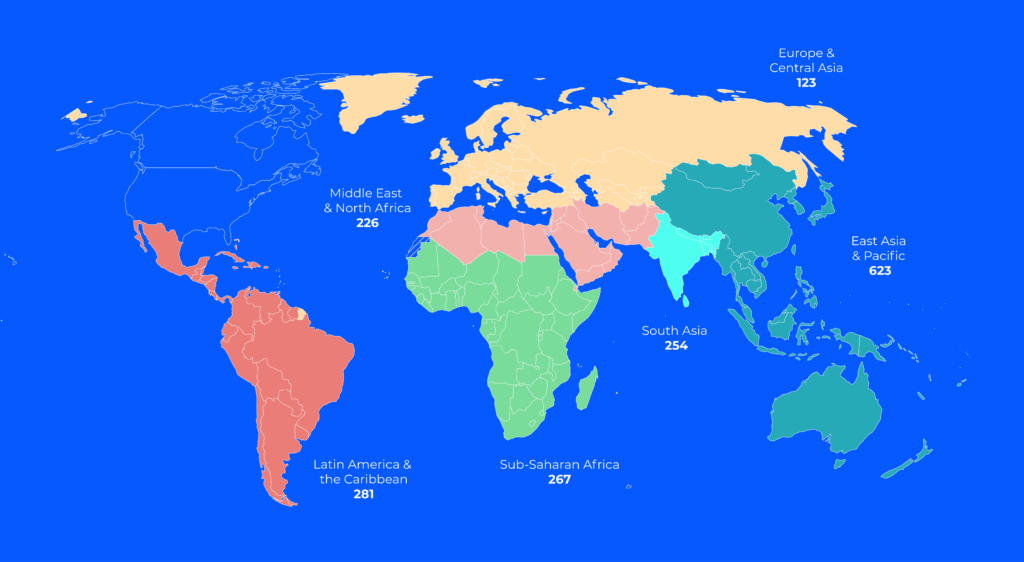
For too long, AI + education resources center voices and research from the Atlantic and Global North. Signal Library, from EdTech Hub’s AI Observatory, flips this by surfacing developments specifically relevant to education in Africa, Asia, the Arab World, and Latin America — resources that are often harder to find and access. To date, there are over 2,000 signals from around the world, a number which will continue to grow as Signal Library is updated regularly.
2,000+ of signals to date from around the world that explore the latest developments relevant to AI and education in low- and middle-income countries.
What makes Signal Library different?
1️⃣ First-of-its-kind: This is the first ever signals database specifically monitoring, gathering and curating AI developments relevant to education systems in low- and middle-income countries. No paywalls. No hidden costs.
2️⃣ Built by people who understand education systems: Backed by EdTech Hub’s research across 70+ countries in Africa, Asia, and the Arab World. Refined with feedback from early access users including education advisors, specialists, and senior teacher development officers working in these contexts. This isn’t a bot — it’s human insight at scale.
3️⃣ Expert curation you can trust: Leading voices in AI and education select and contextualise resources relevant to different regions, with the ability to filter signals that have been highlighted by EdTech Hub or AI Observatory teams. Their expertise — combined with AI-powered discovery — ensures you’re not drowning in noise, but finding what matters.

Meet Signal Library’s first Guest Curator: Daniel Plaut
To mark the launch of Signal Library, Guest Curators highlight three resources — two discovered through Signal Library, and one exclusive resource from their own work — with context on why it matters for navigating developments in AI and education across low- and middle-income countries. Signal Library’s first Guest Curator is Daniel Plaut, Program Director for Global Education with R4D.
Daniel works as a learning partner to education implementers to further their impact and strengthen systems. He is currently the Program Director for Global Education with R4D and serves as Global Learning Lead for EdTech Hub’s AI Observatory and Action Lab, where he supports education decision-makers in navigating the opportunities and challenges of AI in education. Here’s Daniel’s curation:
1️⃣ Designing AI agents for many voices
? [Spotted by Signal Library’s Human-AI scanning system; Source: World Economic Forum].
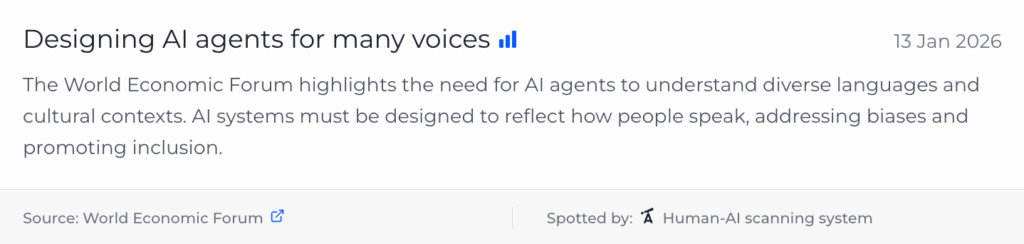
| “This article provides a brief summary of why building AI models that represent the world’s many languages is crucial. It argues that language is not only identity, but that it is core to understanding the needs of different communities. The article also proposes a number of key steps for investing in and working towards AI that is built to be cross-cultural.” |
2️⃣ A new direction for students in an AI world: Prosper, prepare, protect
? [Spotted by Signal Library’s Human-AI scanning system; Source: Brookings]
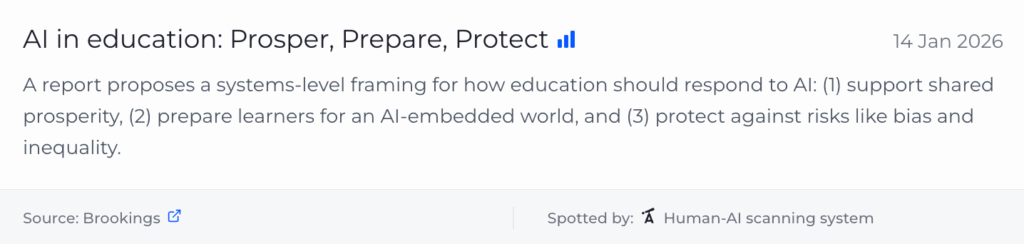
| “This blog and connected report offers a systems-level framing for how education should respond to AI: Prosper, Prepare, Protect. In short, it argues that AI in education should (1) support shared prosperity rather than concentrate advantage, (2) prepare learners for a world where AI is embedded in work and society, and (3) protect students and systems from risks like bias, misuse, and widening inequality. Very thoughtful approach!” |
3️⃣ AI and the future of pedagogy
? [Daniel Plaut’s independent selection; Source: Sage]
| “This really interesting white paper argues that AI should be integrated into education as a catalyst for deeper, human-centered learning rather than a shortcut that automates or hollows out core skills like critical thinking, judgment, and metacognition. It draws on learning science and the history of educational technology to call for grounding AI use in cognitive principles (e.g., managing cognitive load, scaffolding, feedback) and rethinking learning assessment to focus on how students think, not just what they produce. Importantly: the paper emphasises that educators must remain central as designers and ethical stewards, to ensure that AI elevates rather than displaces human capability.” |
Want to be our next Guest Curator?
We’re building a growing network of voices shaping how education stakeholders understand AI developments. If you’re working on AI policy implementation, digital transformation, or education research in low- and middle-income countries, we’d love to hear from you.
Two more tools to help navigate AI and education are coming soon…
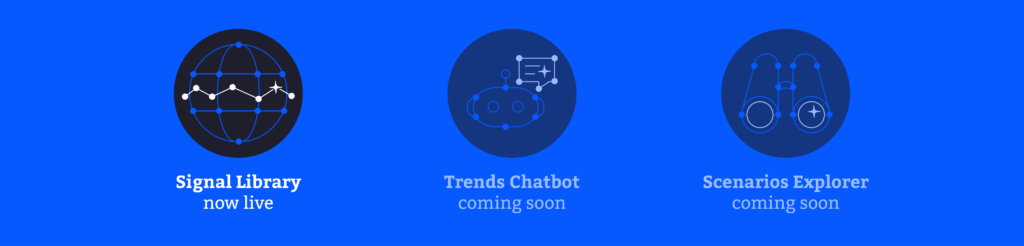
Trends Chatbot
Generates trend reports based on your topic and region of interest and helps you tease out the implications for your context.
Scenario Explorer
Explore future scenarios and identify strategic responses.
As part of the early access phase, we invite you to use the tools and provide feedback through a short survey or a brief interview. This is optional and will not influence your access to the tools. However, if you do offer feedback, your input will be invaluable in helping us refine the tools to meet the needs of decision-makers across diverse contexts.
EdTech Hub’s AI Observatory is made possible with the support of the UK’s Foreign, Commonwealth and Development Office.