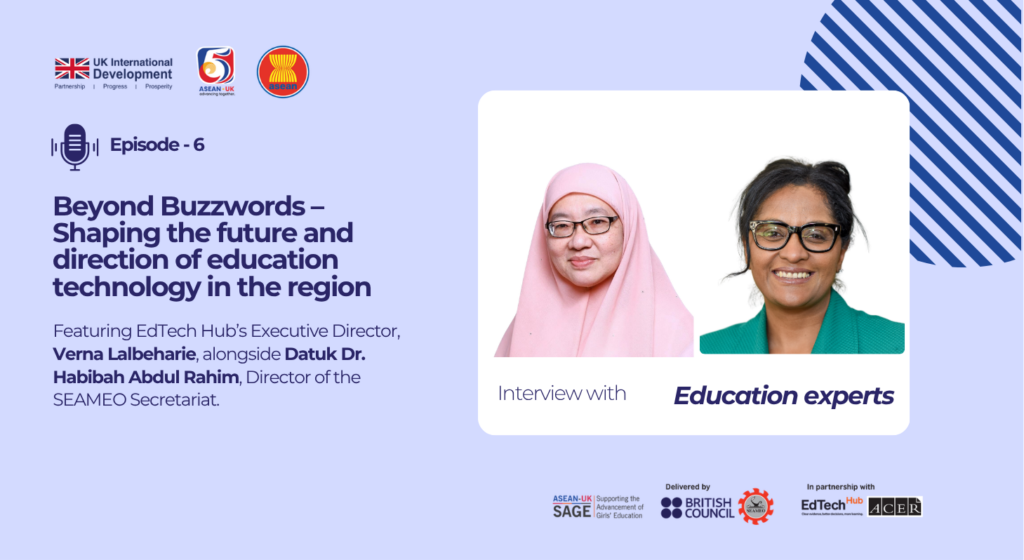
As the Beyond Buzzwords series comes to a close, this final episode reflects on the broader questions that have emerged across the region’s conversations on education and technology. From partnerships and financing to AI, governance, ethics, and evidence, the series has highlighted a recurring point: the future of education technology will be shaped not only by new tools but also by the systems, priorities, and values that influence how those tools are used.
Hosted by Neema Jayasinghe, this closing conversation brings back Datuk Dr Habibah, Director of the SEAMEO Secretariat, and Verna Lalbeharie, Executive Director of EdTech Hub, to reflect on what these issues mean for Southeast Asia and what they suggest about the future direction of education in the region.
Taken together, these conversations point to a shared challenge. As interest in education technology continues to grow, questions of implementation, equity, sustainability, and purpose remain central. This final episode, therefore, steps back from individual topics to consider the bigger picture: what should matter most for the region, where the greatest risks and opportunities lie, and what it will take for technology to support more meaningful and equitable learning in the years ahead.
Watch the Episode Here
Read the play-by-play of the conversation below:
Question 1: Based on your experience in Southeast Asia, what shifts have you seen in approaches to teaching and learning foundational skills, and what do those changes tell us about the broader education landscape?
Datuk began by pointing to a fundamental shift in how education systems across Southeast Asia are engaging with evidence. Drawing from regional assessments such as SEAPLM, she noted that countries are now better able to understand learning outcomes and the factors shaping them—from urban-rural divides to gender disparities and access to early childhood education.
She emphasised that the real change lies not just in generating data, but in how governments are beginning to use it. Countries are increasingly translating evidence into policies and interventions, and are also starting to look beyond assessment itself—examining implications for curriculum, instruction, and teacher training across the system.
Verna built on this by situating the shift more broadly. She observed a move away from technology-first thinking toward learning-first thinking, where tools are seen as secondary to pedagogy and national priorities. She also highlighted a parallel shift in partnerships—from traditional donor-recipient models toward co-creation. This, she argued, reflects a deeper recognition that sustainable change requires systems thinking, not isolated innovation.
At the same time, she cautioned that while systems are increasingly data-rich, they are not always effective at using that data—pointing to a persistent gap between evidence and decision-making.
Question 2: What do you see as priority areas for Education in the next 5-10 years, and how do you imagine the role of technology in advancing these goals?
Turning to the future, the conversation focused on what should take priority as education systems navigate the next decade.
Verna grounded her response in the reality of the global learning crisis. Stressing that millions of children still lack foundational literacy and numeracy, this must remain central to all education efforts. She pointed to three key priorities: strengthening foundational learning, addressing inequities affecting marginalised groups, and keeping system strengthening at the core. Technology, she emphasised, should play a supporting role—not lead the agenda.
She also underscored the diversity of Southeast Asia, noting that there are no one-size-fits-all solutions—only approaches shaped by context.
Datuk echoed this from a regional perspective, highlighting SEAMEO’s priorities, including early childhood education, inclusion, resilience, teacher development, and 21st-century skills. She described technology as a cross-cutting enabler, alongside themes such as equity, gender, and sustainability, but stressed the need for flexibility so countries can adapt approaches to their own contexts.
She also noted a broader shift in how regional organisations engage—moving away from prescribing solutions toward more collaborative, country-led approaches.
Question 3: In the ASEAN-UK SAGE programme, EdTech is a cross-cutting theme. Where do you see technology adding the most value for improving foundational learning, and where is it most likely to distract or add burden?
Datuk framed technology as a powerful but conditional tool. She highlighted its role in expanding access, supporting teacher development, and enabling system-wide connections across countries. However, she also noted a growing disconnect: while digital access has increased significantly, learning outcomes have not improved at the same pace. This underscores the limitation of focusing on access alone.
She emphasised that technology becomes a distraction when it is introduced without a clear purpose, alignment, or support for teachers.
Verna reinforced this by describing technology as an enabler—a facilitator rather than a solution in itself. She cautioned against deploying edtech without clearly defined learning outcomes or mechanisms to measure impact.
She also highlighted the realities on the ground, where many teachers are already experimenting with tools, including AI, but often without guidance, institutional support, or resources—and sometimes at personal cost. For her, this underscores the need to invest not just in tools, but in teacher readiness and support systems.
Question 4: What do you think governments, educators and development partners need to pay more attention to for successful implementation?
Moving on to what it takes to turn ideas into action, and why implementation so often proves to be the hardest part.
Verna emphasised the importance of having clear national strategies and roadmaps. Without these, she noted, efforts risk becoming fragmented and ineffective. She also highlighted the importance of trust—particularly in the context of AI—including strong governance frameworks around data privacy, child safety, and responsible use.
In addition, she stressed the need for investments in culturally and linguistically relevant tools, ensuring that technology aligns with the contexts in which it is used.
Datuk agreed, adding that while regional declarations are important, they must be translated into actionable plans—and followed by monitoring, evaluation, and learning. She identified sustainability as a critical challenge in the region. While many initiatives begin as successful pilots, sustaining and scaling them beyond initial funding remains difficult.
To address this, she emphasised the need to:
- Integrate initiatives into national systems
- Build local capacity
- Engage stakeholders at the ground level
Without these elements, even promising interventions may not endure.
Question 5: With the rapid pace of innovation in education technology, where should stakeholders be focusing their efforts to ensure equity and inclusion aren’t left behind?
As the pace of innovation accelerates, the conversation highlighted what must be done to ensure equity and inclusion remain at the center.
Datuk stressed that technology has the potential both to reduce and to deepen inequalities. Ensuring that all learners benefit requires attention to infrastructure, accessibility, and teacher capacity. She emphasised that teachers remain central to this effort, and that sustained professional development is essential for ensuring that technology supports, rather than hinders, equitable learning.
Verna expanded the discussion by challenging assumptions about access. She pointed out that even when connectivity barriers are addressed, usage for learning does not automatically follow.
She cited examples where access to the internet or devices did not translate into meaningful educational engagement, due to factors such as limited content, low digital literacy, or lack of motivation. This, she argued, highlights the need to think beyond access—to ensure that learners also have access to high-quality, relevant, and usable digital resources.
**Correction:** Upon answering Question 5, Verna noted that in a previous episode of the Beyond Buzzwords series, the research director of Equitable Education Fund provided an example of SIM card usage, this is actually from a previous webinar EdTech Hub organised to launch the Southeast Asia AI in Education. Topic Brief Series, which is accessible here.
Question 6: What is one thing you wish someone had told you before working in the education space in the region that you think other stakeholders should know too?
In reflecting on their journeys, both speakers pointed to lessons that continue to shape how they approach this work today.
Verna reflected that one of the most important realities in education is its inherent complexity. There are no quick fixes or one-time solutions to the learning crisis—progress requires sustained, iterative effort and a willingness to adapt over time. What is often underestimated is how long meaningful change takes, and how easily systems can default to oversimplified approaches.
At the same time, she emphasised a more optimistic truth: effective solutions do exist. The real challenge lies in identifying what works, aligning on what “good” looks like, and creating the conditions for those solutions to be adopted, adapted, and sustained at scale.
Datuk highlighted the importance of trust, shared purpose, and collaboration, particularly when working across a diverse region. Moving from a single-system perspective to a regional one underscored for her that progress depends as much on relationships and mutual understanding as it does on technical solutions.
She also stressed that evidence must be actively used—not just produced. Too often, insights remain within reports when their true value lies in informing decisions and shaping action. For her, the key lesson is that impact comes from translating knowledge into practice through strong partnerships and sustained engagement.
This episode draws on expertise from the following discussants:
- Datuk Dr Habibah Abdul Rahim, the Director of the Southeast Asian Ministers of Education Organisation (SEAMEO) Secretariat. She is also Professor Honourary at Kyungwoon University, Honourary Fellow at MASA Institute, Board Member of Teach for Malaysia, Advisory Board of Universiti Pendidikan Sultan Idris, and Member of Global Advisory Council of Teach for All’s Global Institute. She is the former Director General of the Ministry of Education Malaysia and has extensive experience in policy development, macro planning, programme delivery and evaluation. She played a key role in the development of the Malaysia Education Blueprint 2013-2025 (Preschool to Post Secondary Education).
- Verna Lalbeharie, the Executive Director of EdTech Hub, leading the Hub in advancing its mission to empower governments and leaders towards evidence-based applications of technology in education, in service of building an evidence-driven movement for the use of technology to help address the global learning crisis. Verna has over 25 years of experience in strategic leadership and business development in education technology, personalised learning, research, and technical assistance. She has focused her career on evidence and the advancement of education technology to create a more equitable future for all students.
This marks the final episode of the six-part Beyond Buzzwords series, which has brought together experts to examine the key questions shaping technology and education across the region. The series is supported by the ASEAN-UK SAGE programme, which is now concluding its first phase of work across the region. To learn more about EdTech Hub’s work under the ASEAN-UK SAGE programme, please visit our website.
Statement of disclosure
This blog was developed with support from generative AI. A transcript of the recorded session was generated, and the content was organised into question-based segments, which were then provided to an AI tool to assist in the drafting and structuring of this piece.
Acknowledgements: Thank you to Datuk Dr. Habibah Abdul Rahim, Director of the SEAMEO Secretariat and Verna Lalbeharie, Executive Director at EdTech Hub, and all those at EdTech Hub supporting this work, including Neema Jayasinghe, Sangay Thinley, Jazzlyne Gunawan, Jillian Makungu and Sophie Longley, on developing this final episode of the EdTech Hub Spotlight Series.
This work is part of the portfolio of projects delivered by the ASEAN-UK SAGE programme. The ASEAN-UK SAGE programme is delivered by the British Council and SEAMEO Secretariat, in partnership with EdTech Hub and Australian Council for Education Research (ACER). ASEAN-UK SAGE is an ASEAN cooperation programme funded by UK International Development.