
Introduction
The mainstream debate on AI and education has settled into two familiar camps. The optimists point to a wave of tools promising personalised learning, teacher support, and reduced admin. The sceptics catalogue the risks: algorithmic bias, data privacy, the erosion of critical thinking.
At the EdTech Hub AI Observatory, our starting point is different. We know AI is happening, so how can we narrow the learning divide in the age of AI?
This year, we’re delighted to see that the Education World Forum – the world’s largest gathering of education leaders – has set their theme as: how can education remain human-centred and purpose-driven in an era of rapid AI advancement?
We’ve spent the past few years horizon scanning, developing a theoretical framework and running a hypothesis-driven Action Lab to test ideas that we believe can meaningfully move the needle. What we’ve found is that the conversations happening at forums like EWF tend to focus on use cases; can AI improve teaching quality? Can it drive efficiencies in a Ministry of Education? The answer to both is yes, conditionally. The condition is that the rest of the system is considered too: the enabling environment, the implementation science, the incentives, the infrastructure.
So when you’re in a session at EWF and an AI use case is being presented, here are the questions worth pushing on. For each question we include a signal from our Signals Library of how others are considering these questions.
The 6 Questions
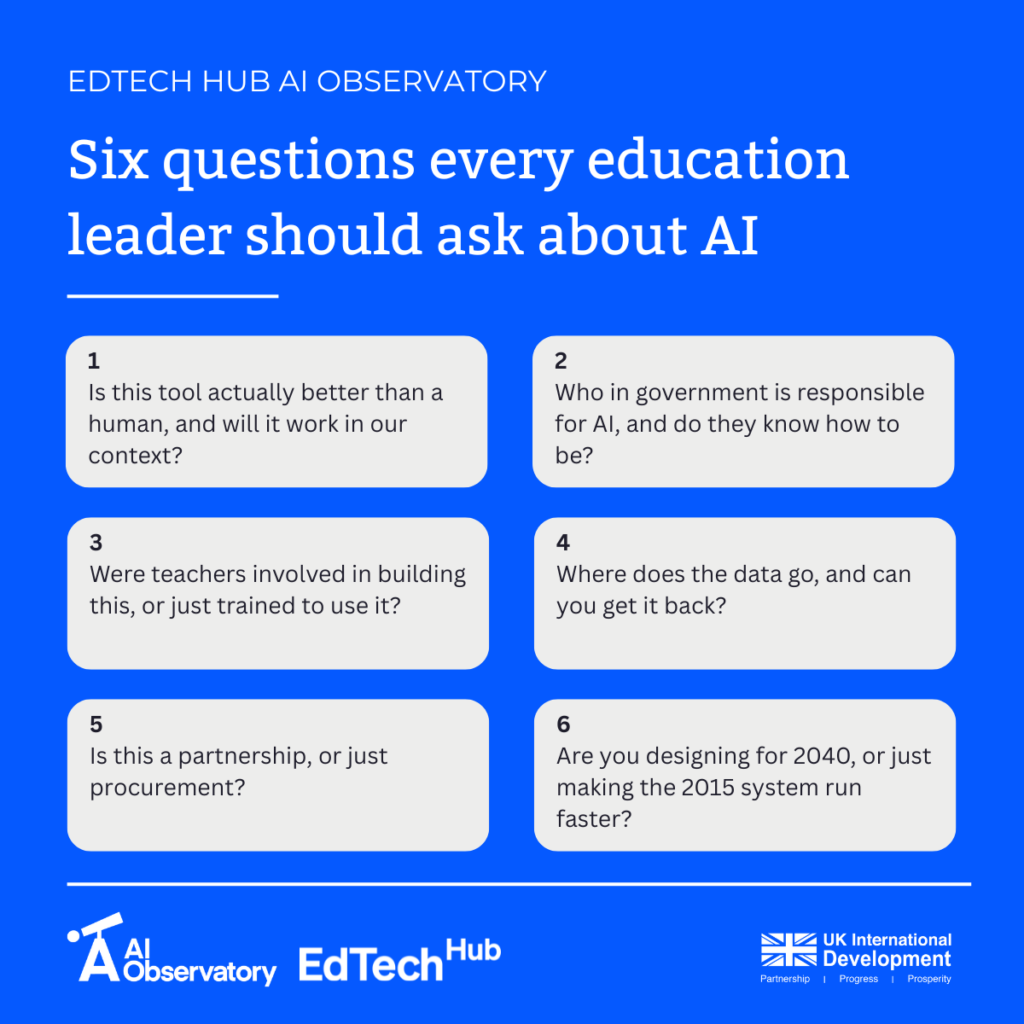
1. Is this tool actually better than a human, and will it work in our context?
Most procurement decisions in AI for education are made on the basis of demos and projections, not trustworthy evidence. Two questions that should be asked together: does this tool actually outperform what a human does? And does the infrastructure exist for it to work reliably where it will be deployed?
The efficiency argument says AI can do certain tasks faster and at lower cost. The quality argument says AI can produce better learning outcomes. These don’t always hold simultaneously. An AI tutoring system that reaches a million students at a fraction of the cost may still produce worse outcomes than a well-supported teacher. And that’s before accounting for what happens when the power goes out, the connectivity drops, or the devices aren’t there.
Infrastructure isn’t a pre-condition someone else will sort out, it’s part of the cost-benefit calculation. A tool that works in a well-connected urban school and fails intermittently in a rural one isn’t neutral. It systematically advantages the students who already have more.
Signals we’re seeing:
A recent Brookings study suggests that AI-enabled personalisation works best when teachers are closely involved, and carries greater risks when they are not (Burns et al., 2026) — a finding consistent with evidence from AI-enhanced digital personalised learning (DPL) programmes in Kenya and India, where teacher involvement was not incidental but structural to effectiveness (Adam & Lester, 2025). [EdTech Hub Trend Report: Learners in the Age of AI]
Delphi panellists in a recent Brookings study (Burns et al., 2026) echoed a concern raised by Mike Trucano in 2023: “Is it possible to imagine a future in which a new digital divide emerges: where the rich have access to technology, increasingly powered by artificial intelligence, and to teachers to help them use this technology as part of their learning, while poor kids just have access to the technology?” (Trucano, 2023) [EdTech Hub Trend Report: Learners in the Age of AI]
2. Who in the government is responsible for AI, and do they know how to be?
Most governments are looking at how they can harness AI in education. Do these people have what they need to make good decisions? Not just authority, but genuine understanding of what AI can and can’t do, the mindset and environment that allow them to take risks while also safeguarding learners, or the methodology and processes to experiment?
The EdTech Hub AI Observatory has been working directly with ministries through the Ministry of Education AI Challenge, and we’ve found the biggest barriers to effective AI adoption are not technical. Procurement processes, coordination challenges, governance gaps, and change management consistently prove harder to solve than the tools themselves. Decision-makers need resources, support, guidance and information, not just access to tools, platforms or subscriptions.
Officials who lack a clear picture of what AI can do often default to familiar but limited ideas, and are sometimes missing the applications that could genuinely lead to improved learning outcomes. This isn’t a criticism of individuals. It’s a systems problem. System readiness and institutional capacity need as much deliberate investment as the technology itself.
Signals we’re seeing:
In this World Bank article, Saavedra and Molina argue that AI adoption in education is limited by organisational culture, not infrastructure. They highlight an ‘imagination gap’ in institutions. (Saavedra & Molina, 2026)
Along with formal policies and processes, trust between stakeholders is key. EdTech Hub Specialist, Shakil Ahmed, writes in his three-part series on AI and education: “without trust, networks collapse into competition, delivery units become turf wars, and frameworks gather dust.” (Ahmed , 2025) [Waypoint Wednesday, Issue 26]
3. Were teachers involved in building this, or just trained to use it?
Co-design and consultation are not the same thing. An AI tool demonstrated to teachers at a national rollout event and then deployed across a school system is not a teacher-centred approach. Neither is a survey sent to a sample of educators after the product roadmap has already been agreed.
The evidence from the AI Observatory’s Teachers-in-the-Lead Sandboxes suggest that tools that actually improve teaching tend to be built with teachers from the start, not handed to them at the end. This isn’t primarily about buy-in, it’s because teachers hold knowledge about their classrooms, their students, and their constraints that no product team has.
But efforts for teacher involvement require more precision. Saying teachers must be central to AI adoption is easy; doing it well is not. Co-design risks becoming an additional burden on already stretched professionals if the when, how, and purpose are not carefully defined.
Signals we’re seeing:
The World Bank documented a people-centred approach to ensure technology empowers rather than displaces the human element in education. Focus groups with public-school teachers in Lima explored how AI could support their work, and innovative teachers were invited to co-design training materials and classroom use cases. (World Bank, 2025; Microsoft, 2025) [Waypoint Wednesday, Issue 20]
HESEIA is a dataset of 46,499 sentences co-designed with 370 teachers and 5,370 students from 189 Latin American schools. It captures intersectional biases across demographics and subjects, reflecting local contexts. It aims to support bias assessments grounded in educational communities. (Ivetta et al., 2025)
4. Where does the data go and can you get it back?
Most AI platforms deployed in education systems across the world are built, hosted, and governed in a small number of countries. The training data, the model improvements, the behavioural insights generated by millions of student interactions, adds value to a company headquartered in another country, operating under another country’s law, and built on various biases. The education system that deployed the tool typically has no right of access to aggregated insights, no ability to audit the model’s behaviour, and no leverage if the pricing changes or the product is discontinued.
The question of who owns the infrastructure and who captures the value created by AI in education is a question about whether countries are building capability or building dependency.
Signals we’re seeing:
In Mauritius, EdTech companies are required to register as ‘data controllers’, declare their data processing activities, and conduct Data Protection Impact Assessments for high-risk operations involving student data. However, UNICEF Innocenti’s research suggests very few countries have the resources to oversee these duties. (UNICEF Innocenti, 2025) [Waypoint Wednesdays, Issue 25]
Designed to ensure equitable benefit-sharing, Lelapa AI created a novel community-centric data license in which native-speaking communities retain ownership of their linguistic data, receiving licensing fees from commercial entities. (Rajab et al., 2025) [Waypoint Wednesday, Issue 27]
5. Is this a partnership or just procurement?
The word “partnership” does a lot of work in the AI for education space. It appears in MoUs, in conference panels, and in press releases from governments and technology companies.
Genuine partnership implies shared goals, shared risk, and shared accountability for outcomes. We should be asking what the private partner loses if learning outcomes don’t improve. Or whether the agreement includes impact metrics, or just usage data. And whether the government has the right to walk away, or whether the terms of the relationship make exit practically impossible after a few years of dependency.
The AI Observatory’s framework identifies partnership alignment as one of the six core levers for narrowing the learning divide. The emphasis is on the word “aligned” and ensuring it is mutually beneficial.
Signals we’re seeing:
Where formal education has been slow to establish robust AI literacy frameworks, technology companies have moved in to fill the gap — rewriting what literacy means in ways that serve their products rather than learners (Pangrazio, 2026) [EdTech Hub Trend Report: Learners in the Age of AI]
EdTech Hub is researching how low- and middle-income countries (LMICs), as the primary provider of public education for their citizens, can mitigate against undue influence and control through AI products from the global EdTech private sector, whilst leveraging the potential benefits of their enhancements in education. The research co-generates learning with Ministry of Education officials from various countries. (Adam, 2025) [Waypoint Wednesday, Issue 27]
EdTech Hub sat down with Datuk Dr Habibah Abdul Rahim, Director of the SEAMEO Secretariat, to unpack what makes partnerships in education technology truly inclusive, equitable, and sustainable. (EdTech Hub, 2025)
6. Are you designing for the education system your country needs in 2040, or just making the 2015 system run faster?
The AI Observatory’s three horizons framework makes a distinction that we think isn’t getting enough attention: upgrading existing systems (Horizon 1) is not the same as designing education for a world where AI is already a feature of daily life (Horizon 3). Most actors are doing the former.
But the Horizon 3 questions need to be on the table at the same time. What is school for when AI can produce a competent essay, pass a standardised test, write functional code? What does a curriculum look like that prepares students for that world, rather than preparing them to compete with it? What does assessment look like? What does the role of the teacher look like?
If we don’t design for it intentionally, the answers will be decided by others. The AI Observatory is running a Field Trip to the Future series to explore what that design could look like — sign up here to hear about the upcoming sessions.
Signals we’re seeing:
In the EdTech Hub AI Observatory’s Trend Report: Learners in the Age of AI, we note that the growing emphasis on closing the “AI skills gap” may quietly narrow the purpose of education by framing it mainly as preparation for an AI-ready workforce (Weatherall, 2026)
Writing in the Stanford Social Innovation Review, Isabelle Hau describes relational intelligence as the human capacity to build trust, navigate conflict, and create shared understanding with others. Hau argues that as AI systems take on more cognitive and analytical tasks, the capabilities that become most valuable may be relational. (Stanford Social Innovation Review, 2026) [Waypoint Wednesdays, Issue 33]
The Learning Planet Institute has mapped more than one hundred learning ecosystems in the Global South and conducted deeper studies of 11. Many of these community-driven educational models place explicit emphasis on helping learners thrive within their communities, proposing a broader objective for education. (Learning Planet Institute, 2024) [Waypoint Wednesdays, Issue 33]
What’s Next
We hope these six questions will prompt your thinking and conversations around this year’s Education World Forum. We’d love to hear your perspective how to narrow the learning divide in the age of AI.
Share the 6 Questions
The AI Observatory publishes evidence, and emerging practice from across the global AI in education landscape. Explore more of our work at https://edtechhub.org/ai-observatory/, and the full library of Signals at https://www.ai.edtechhub.org/en/signals. It is made possible with the support of the UK’s Foreign, Commonwealth and Development Office.