Overview
Education systems operating in emergency and crisis contexts face a huge challenge: how to ensure continuity of learning under severe constraints. On Tuesday, 7 July 2026, EdTech Hub hosted a webinar that explores just this – how technology can support learning continuity in crisis settings. We convened researchers, practitioners, and education experts to discuss this topic, focusing particularly on the role of pedagogy and teachers in using EdTech for continued learning. This recap captures the key highlights from the discussion to reimagine technology’s role in supporting children’s continued education in the most vulnerable conditions.
Drawing on experiences from the Kurdistan Regional Government (KRG) and UNRWA, our panellists reflected on what the evidence and implementation experience tells us about designing and implementing tech-enabled approaches that support quality teaching and learning in emergencies. Reflections from discussants from the UK Foreign, Commonwealth and Development Office (FCDO) and EdTech Hub provide practical insights into how organisations which focus on supporting education system resilience and responding to the particular stresses experienced by children can improve learning outcomes in emergency education responses.
Watch the full webinar and read the summary
Understanding teaching and learning as a fundamentally social, interactive process.
During the discussion, the panellists all highlighted the importance of looking at technology as an enabler, not a driver of change. This included a focus on leveraging technology to support children’s continued experience of fundamental teaching and learning processes.
Teaching and learning is a fundamentally social interactive process, so we need to be looking for technology that facilitates that process. This is especially important in emergency settings.”
– Katrina Barnes, EdTech Hub
Zuhair M. Abdullah from the Kurdistan Regional Government and Unai Sacona from UNRWA both shared this sentiment. Zuhair noted the importance of interactivity when designing the MySchool platform, built to support children’s continued learning during school closures caused by the outbreak of war. Unai spoke about improving education access in crises by leveraging existing digital tools that let students interact with educators as part of their learning.
The panellists highlighted that introducing technologies in typically ‘no-tech’ settings naturally presents challenges. Teachers need time to build the digital literacy and pedagogical skills required to integrate technology into their own classrooms. Zuhair’s advice to others attempting similar rollouts: give teachers room and support to adjust, because the payoff extends well beyond the tool itself.
For our teachers, the initial experience wasn’t just about learning a new interface; it was about reconciling digital requirements with the harsh reality of classroom limitation during the conflict. But then teachers start moving from scepticism to necessity when they realise that MySchool provides them with the sense of continuity when physical schools are closed.”
– Zuhair Abdullah, Kurdistan Regional Government
Ensuring education systems are resilient preceding any crisis
Lisa Walker, UK FCDO Education Advisor, drawing both from Zuhair and Unai’s insights and growing evidence of the importance of preparedness planning (see for example, Radford et al, 2026), reinforced the importance of building the foundations of a resilient system even before a crisis emerges. This includes both infrastructural resilience, and government support and leadership.
Resilience can’t be built during a crisis alone. The capabilities that enable learning continuity during emergencies are often the same capabilities that improve teaching and learning during more stable periods.”
– Lisa Walker, UK FCDO
Zuhair noted that because conflict frequently disrupts learning in and around the Kurdistan region of Iraq, the MySchool platform was built to keep education going through emergencies, giving students equal access to digital resources and helping teachers deliver them. The vision: a resilient education system where every student can learn, in and outside the classroom. Built by the government with input from educators and stakeholders, and backed by teacher training beforehand, the interactive, AI-powered platform made the shift from offline to online far easier.
Similarly, Unai noted that UNRWA’s strong presence in the West Bank and Gaza, including educational and infrastructural capacity and political standing, allowed it to make the shift to tech-enabled learning quickly. In the West Bank, UNRWA was also able to transition swiftly to tech-enabled learning thanks to the agency’s long-term work across four strategic areas: schools’ and students’ access to suitable devices and hardware; reliable internet connectivity across schools and in the field; curriculum-aligned learning resources; and capacity building for teachers in digital pedagogy. Meanwhile, in both the West Bank and Gaza, WhatsApp has emerged as a crucial everyday tool that facilitated the shift to distance learning due to its low complexity and high familiarity with learners.
We want to be prepared, because we know emergencies happen and we need to move very fast into full distance, and we need to ensure we are able to do that move.”
– Unai Sacona, UNRWA
Reducing cognitive load and focusing on context-aware co-design.
In emergency situations, children are faced with compounding vulnerabilities and challenges. Experiencing displacement, interrupted schooling and chronic stress as a result of being in situations of conflict and emergency can harm both their memory and executive function (Radford et al, 2026; Whiting, S. B., et al. 2021; Vogel, S. & Schwabe, L., 2016).
Katrina Barnes from EdTech Hub emphasised that resources for learning in emergencies must be chosen or developed carefully to ensure they support children’s wellbeing and reduce the risk of cognitive overload. One example she shared was Can’t Wait to Learn; an interactive learning platform developed by War Child for use in emergency contexts. In each context where it is deployed (including Ukraine, Lebanon, Sudan, and Uganda), platform content is co-designed with learners to ensure the digital world in which children learn is familiar and safe, and therefore supportive of their wellbeing and cognition. Other ways she mentioned of reducing learners’ cognitive load include using familiar tech as much as possible and opting for highly structured tasks over open-ended ones.
In parallel, Unai mentioned how the familiarity of tools used, (such as WhatsApp) facilitated reach, engagement and accessibility within UNRWA emergency learning responses in the West Bank and Gaza. These tools enabled UNRWA to recreate face-to-face communities in an online setting. UNRWA also positioned teachers at the centre of the response design, giving them clear tasks and training on how to use technologies in the classroom, while also allowing teachers flexibility and space for professional judgement in relation to implementation strategies.
Similarly, Zuhair outlined the central role teachers played in shaping the development of the MySchool Platform in the Kurdistan context. The platform was also designed to encourage independent learning among students through using AI-supported features. These enable students to better navigate content and increase engagement with the learning materials.
What do we take away from the webinar?
Our discussion reinforced how important it is that technology is used to support what we already know are effective teaching and learning strategies in emergencies, rather than reinvent them. This is best done by:
- Building strong foundations prior to a crisis so that digital strategies can be rapidly adapted and rolled out when needed.
- Collaborating with teachers and students to design contextually appropriate tech-enabled education interventions.
- Prioritising familiar, accessible technologies that keep crisis-affected teachers and learners in their comfort zones and support their wellbeing above all.
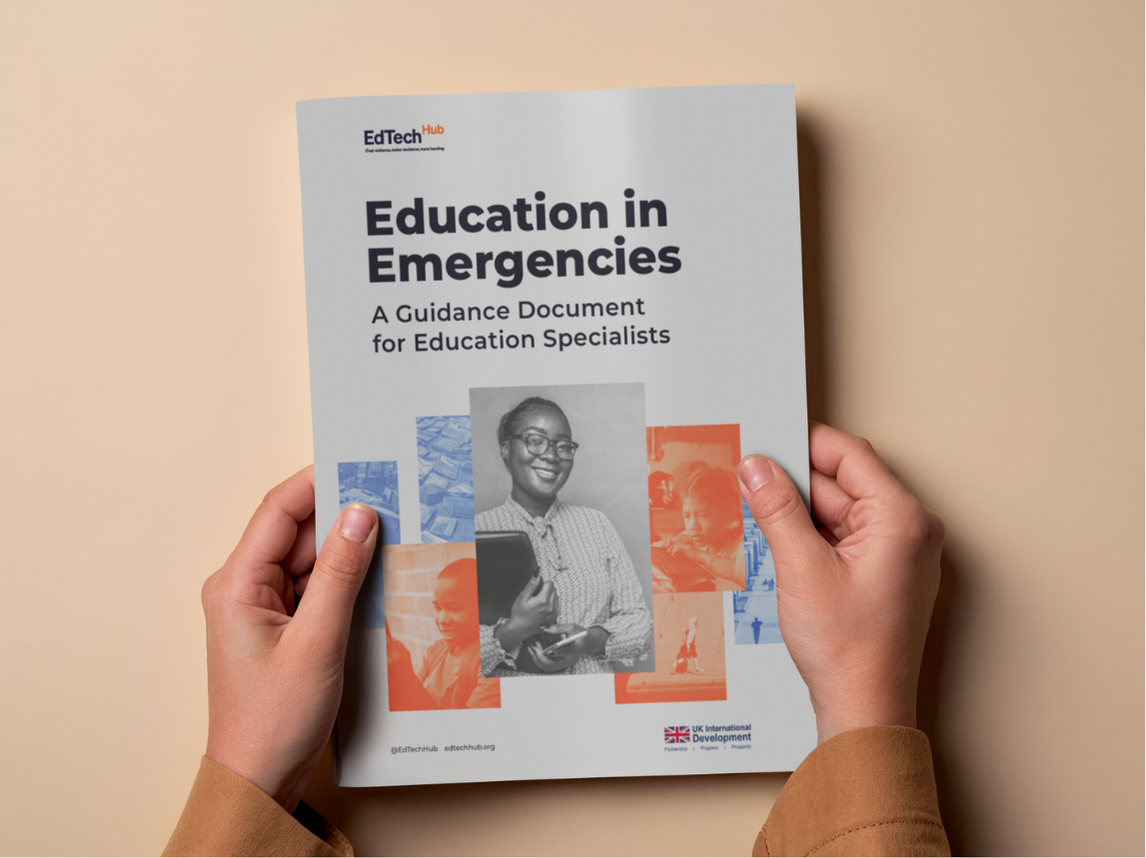
We invite you to explore further by reading our new resource: EdTech for Education in Emergencies: A Guidance Document for Education Specialists.
Key references
- Kurdistan Regional Government of Iraq’s My School Platform (insert link)
- UNRWA Blended Learning Programme ref.
- UNICEF Akelius Digital Language Learning Course:
- Can’t Wait to Learn
- Maths Whizz / iMlango
- EdTech Hub Education in Emergencies Guidance Document
References noted in the text
- Jordan, K. (2023). How can messaging apps, WhatsApp and SMS be used to support learning? A scoping review. Technology, Pedagogy and Education, 32(3), 275–288. https://doi.org/10.1080/1475939X.2023.2201590
- Whiting, S.B., Wass, S.V., Green, S. and Thomas, M.S.C. (2021), Stress and Learning in Pupils: Neuroscience Evidence and its Relevance for Teachers. Mind, Brain, and Education, 15: 177-188. https://doi.org/10.1111/mbe.12282
- Vogel S, Schwabe L. Learning and memory under stress: implications for the classroom. NPJ Sci Learn. 2016 Jun 29; 1:16011. DOI: 10.1038/npjscilearn.2016.11.
Acknowledgements
Thank you to the panellists and their teams for their engagement and support throughout the discussion, Zuhair M. Abdullah from the Kurdistan Regional Government, Unai Sacona from UNRWA, Lisa Walker from UK FCDO. From EdTech Hub we would also like to thank Jazzlyne Gunawan, Kate Radford, Katrina Barnes, Sharanya Ramesh, Sophie Longley, and Haani Mazari for the support and leadership provided that made the webinar a success.