

 Strategic Foresight and Horizon Scanning
Our Strategic Foresight Approach
Policies and programmes based on today’s assumptions can limit our choices, forcing us to react to change rather than shape the future we want.
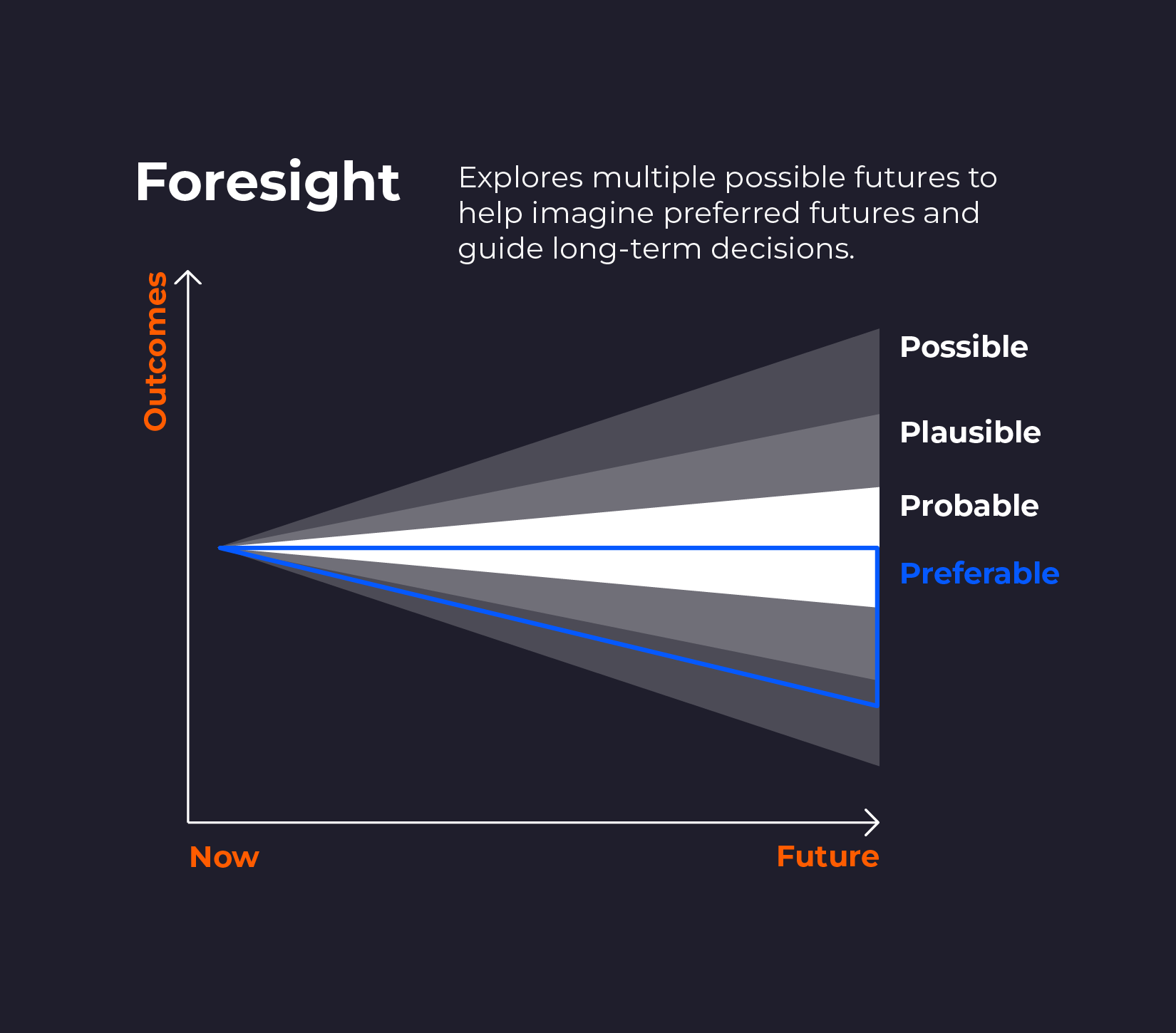
Strategic foresight is a systematic approach to mapping plausible futures to improve current decision-making. By contrasting these potential scenarios with our goal—a future where AI narrows rather than widens the learning divide—we can take more proactive, resilient actions today to help turn that vision into reality.
The AI Observatory applies established futures & foresight methods such as:
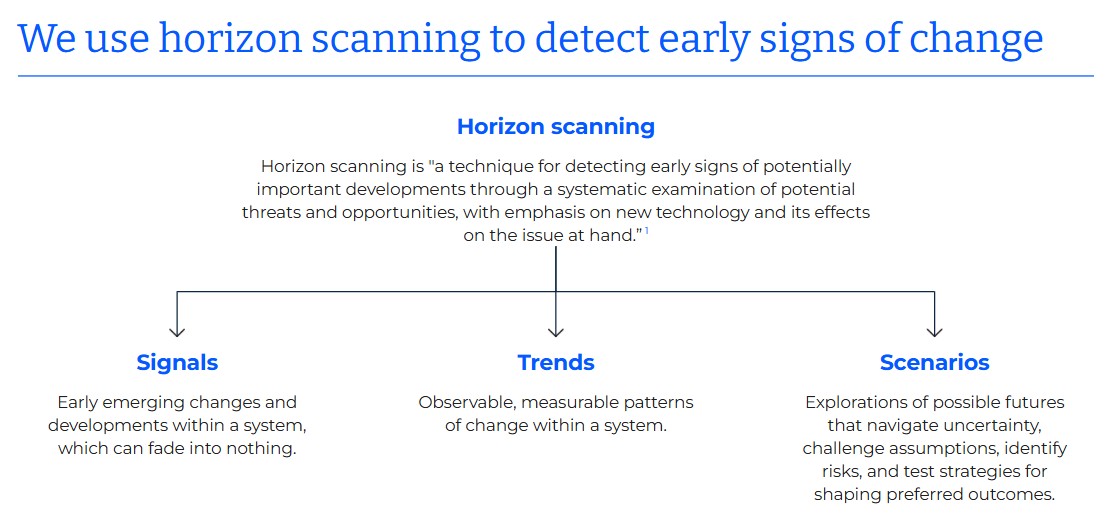
- Horizon scanning – detecting early signals of change, observing measurable trends over time, and exploring possible future scenarios to challenge assumptions, identify risks, and test strategies for narrowing the learning divide in the age of AI
- Scenario planning – exploring what different futures could look like and considering how to respond
- Visioning and backcasting – imagining a desirable future outcome and working backwards to map out the necessary steps to achieve that outcome
Decision-makers can use foresight as:
A strategic early warning system
To anticipate future challenges before they become crises, enabling them to manage strategic surprise.
A way to identify emerging opportunities
Even before strong evidence is available, guiding where to focus evidence-gathering efforts.
A tool for gaining systematic knowledge
Enabling better-informed decisions in uncertain, complex, and interdependent environments.
Practical tips for using strategic foresight:
- Think in multiples – consider several plausible futures, not just the “most likely” one.
- Ask “what if” – explore scenarios that challenge current assumptions.
- Work backwards from your preferred future – identify steps needed to get there.
- Keep it alive – foresight is an ongoing process, not a one-off workshop.
How Do We Narrow the Learning Divide in the Age of AI?
The Challenge
AI in education will widen the learning divide unless we design for the alternative now. Many education ministries struggle to easily assess the effectiveness and safety of AI interventions, nor do they have comprehensive regulations and policies to meet this moment.
Our Role
The AI Observatory & Action Lab uses a hypothesis-driven approach to generate evidence about strategies and approaches that we believe will narrow the learning divide in the age of AI and provide decision makers with timely, practical evidence.
Why Strategic Foresight Matters
Artificial Intelligence is moving faster than most education systems can adapt. The decisions made today about policy, investment, and classroom practice will shape how AI transforms learning for decades to come.
Without strategic foresight and horizon scanning, there is a risk of relying on assumptions that quickly become outdated or are influenced by individual perspectives and experiences, leaving leaders to react rather than shape events.
At the AI Observatory, we use strategic foresight to explore multiple possible futures and horizon scanning to detect early signs of change in AI and education. This allows us to anticipate challenges before they become crises, spot opportunities even when the evidence is still emerging, and help to guide policies and programmes that are both resilient and equitable.
Horizon Scan Methodology
As part of our horizon scanning, we apply a mixed-methods approach that includes:
- Semi-automated web signposting focused on exploring the latest developments relevant to AI and education in low- and middle-income countries, pulling from over 400,000 curated resources (news, grey and academic literature) and translating 56 global languages to English.
- Surveys and qualitative dialogue that crowdsources insight from a wider network of stakeholders, such as teachers, ministers of education across Africa and Asia, technologists, and funders.
Explore Our Horizon Scanning Work
Signal Library
Signal Library surfaces signals of change from credible research, evidence, news and blogs presenting a curated selection of the latest developments relevant to AI and education in low- and middle-income countries.
Sensemaking with Waypoint Wednesday
Stay up to date on emerging developments in AI and education. Our Waypoint Wednesday series shares key signals and trends from around the world, combining expert insight with global scanning.
Teacher-in-the-Loop Survey Findings & Chatbot
What do teachers want when it comes to AI? We ran a pulse survey to generate directional insights into where energy and curiosity about AI currently sits with teachers. Through our Teacher-in-the-Loop survey, we asked teachers for their views on AI in education, and more than 800 responded from 29 countries, including 15 low- and-middle income countries. They ranged from early adopters to the AI-curious and those just starting to explore what’s possible. What stood out most was not just what teachers need, but the role they want to play. Of the survey respondents, 81% said they would be interested in being part of a group that gives feedback on or helps design new AI tools for teachers. This is a clear signal that teachers want to be part of shaping the future, not just being trained to use tools that were created without them.
We turned the insights from this survey into a chatbot so you can hear from the teachers yourself.

Practical Tips for Applying the Horizon Scan Methodology
- Look beyond your sector – disruptions often come from outside your immediate field.
- Pay attention to weak signals – small, early indicators can grow into major shifts.
- Scan regularly – the value comes from consistency over time.
- Link scanning to action – insights are most valuable when they feed into decisions or strategy.
Acknowledgements:
We gratefully acknowledge the AI Observatory Horizon Scanning team — Gita Luz, Gracie Owiti, and Matt Weatherall — for their contributions and work in bringing this approach to life.
Sources:
OECD, (2020), Horizon scanning and foresight methods. Habegger, (2009), “Horizon scanning in government”. UK Government Office for Science, (2022), A brief guide to futures thinking and foresight.Ansoff, H. I., Managing strategic surprise by response to weak signals, (1975). Cuhls et al., Models of Horizon Scanning, (2015) Habegger, (2010), Strategic foresight in public policy. Amanatidou et al., (2012), On concepts and methods in horizon scanning. Frontier Tech Hub, (2024), Kenya Visionary Innovation Master Plan.