
What’s a Learning Brief?
EdTech Hub’s learning briefs are a collection of practical, evidence-backed resources, made for people working to improve the use of technology in education.
Each brief brings together years of expertise from leading players across the EdTech sector, providing key answers to critical questions about implementation, strategy, cost and use, saving you time and effort.
We now have a dedicated series of learning briefs on AI in education, emerging from the work of EdTech Hub’s AI Observatory and Action Lab. These explore how AI tools and interventions are being used in and out of the classroom for teaching, learning and service delivery, specifically in low- and middle-income countries.
Read on for evidence made to be used, so your EdTech interventions work.

Who Could Benefit From Reading These?
- Education policymakers
- Advocacy groups focusing on education policy
- Community leaders and influencers in EdTech
- Donors and funding organisations in EdTech
- Education technology companies
- Government education ministries
- Non-governmental organisations in education
- Researchers
How Is AI Being Used by Education Ministries to Improve Service Delivery in Low- and Middle-Income Countries?
This Learning Brief explores how ministries of education in low- and middle-income countries (LMICs) are using artificial intelligence (AI) to enhance education service delivery. While much of the global discourse around AI in education focuses on teaching and learning, this brief highlights emerging systems-level applications — such as automating administrative processes, improving education management information systems (EMIS), supporting data-driven decision-making, optimising resource allocation, and informing policy and curriculum design.
How Is AI Being Deployed to Support Foundational Learning in Low- and Middle-Income Countries?
This learning brief synthesises emerging evidence on how Artificial Intelligence (AI) is being deployed to strengthen foundational literacy and numeracy (FLN) in low- and middle-income countries (LMICs). Drawing from global case studies and existing analyses, it highlights that AI’s greatest potential lies in amplifying proven, evidence-based practices — structured pedagogy, targeted remediation, teacher support, and language-aligned materials.
Learning Brief 1 of 3 in the AI Teachers’ Series
How Is AI Upgrading Teachers’ Roles in Low- and Middle-Income Countries?
At the earliest horizon, AI works alongside existing systems. Familiar tasks become faster or more consistent, and teachers gain new tools for content creation, administration, assessment, and professional development, without the fundamental nature of their role changing. New demands also emerge: around oversight, adaptation, and professional judgement.
This brief maps the present and emerging uses of AI in LMICs through this lens, covering four use cases: AI for content creation and lesson planning; AI for administrative tasks; AI for assessments, grading, and feedback; and AI for professional development and coaching. For each, it describes the challenges teachers currently face, the potential for AI to help, examples and evidence from real contexts, and the risks to consider.
Learning Brief 2 of 3 in the AI Teachers’ Series
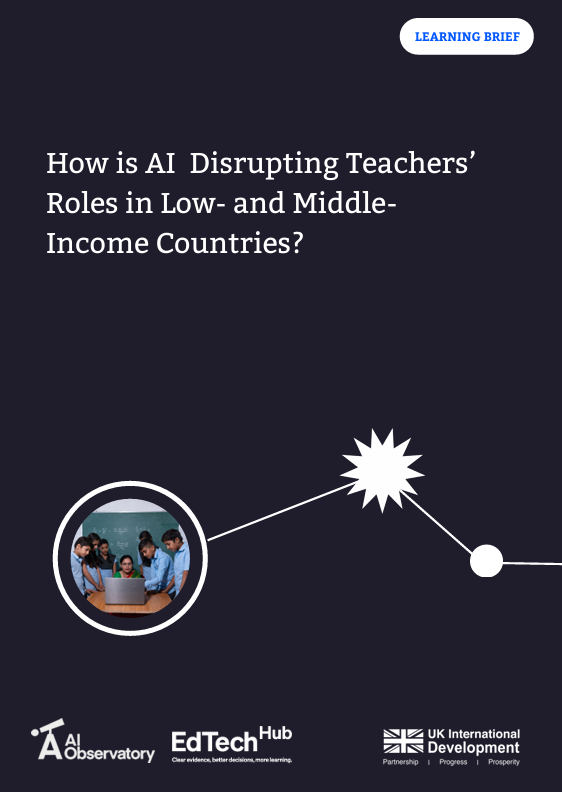
How Is AI Disrupting Teachers’ Roles in Low- and Middle-Income Countries?
As AI becomes more embedded, some of the structures we have long taken for granted begin to feel misaligned. Homework, exams, classroom rhythms, the very logic of how and why we assess learning, all come under pressure. This brief explores what it looks like when AI integration begins to strain the existing structures of teaching and schooling, and what that means for teachers navigating change in under-resourced settings.
Learning Brief 3 of 3 in the AI Teachers’ Series
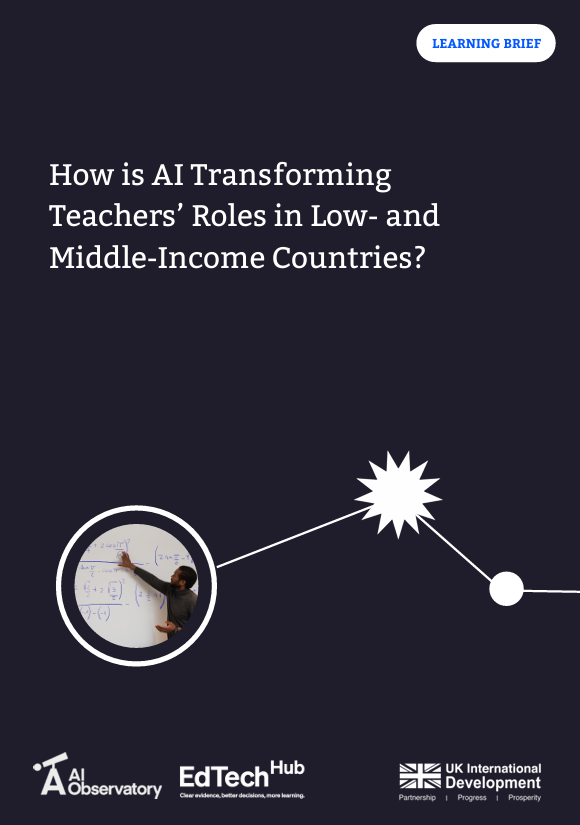
How Is AI Transforming Teachers’ Roles in Low- and Middle-Income Countries?
At the furthest horizon, education is not simply enhanced or disrupted by AI. It is reconceived around it. This brief looks at what teaching could look like when systems are genuinely redesigned for a world shaped by AI, exploring how pedagogical approaches, professional identity, and the relationship between teachers and learners might all evolve.
Your Questions Answered
Please contact EdTech Hub if you have any questions about our learning brief series, or if you would like to share your ideas for new learning brief topics which would help you in your work.