
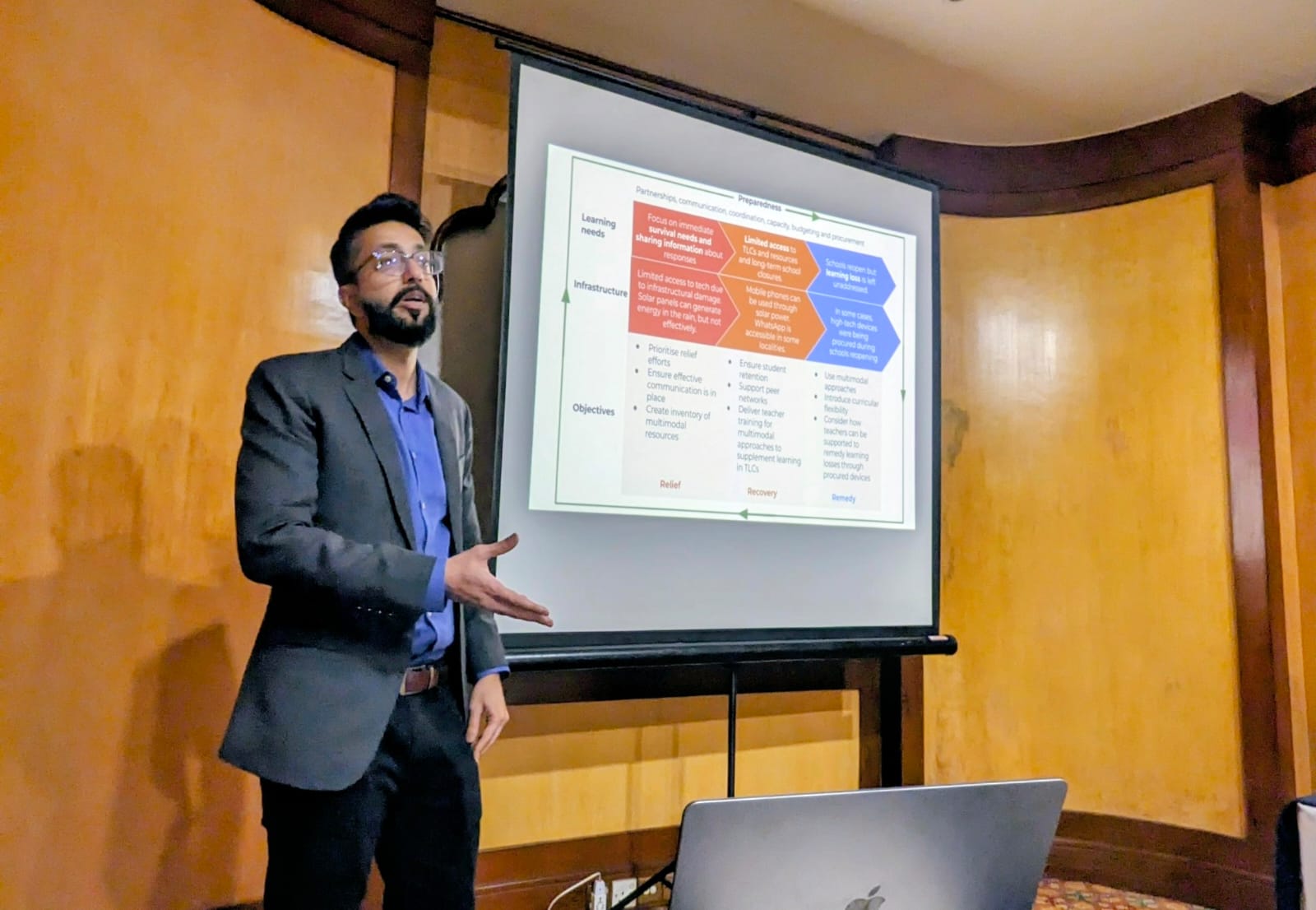
When climate emergencies disrupt learning
Pakistan remains among the countries most vulnerable to climate-related risks, ranking 7.7 out of 10 on the Children’s Climate Risk Index. Across South Asia, an estimated 242 million learners have experienced education interruptions due to extreme heat and seasonal flooding. With more than 26 million children already out of school in Pakistan, protecting learning during seasonal disasters has never been more urgent.
Responses to education disruptions have often focused on immediate relief and the rehabilitation of damaged infrastructure. While critical, this raises an important question:
How can learning continue when classrooms are inaccessible, and education systems are under strain?
It was in this context that EdTech Hub’s Pakistan Country Team, in collaboration with the Education Sector Working Group (ESWG), developed and delivered a training workshop titled ‘Leveraging EdTech to Support Learning Continuity in Climate Emergencies’. The workshop built on EdTech Hub’s earlier research into scalable, feasible approaches to leveraging EdTech in response to Pakistan’s 2022 floods, as well as a related policy brief drawing on perspectives from federal and provincial governments and development partners.
The workshop centred on a simple but important question: How can Pakistan shift from reactive responses to proactive preparedness when learning is disrupted by leveraging technology?
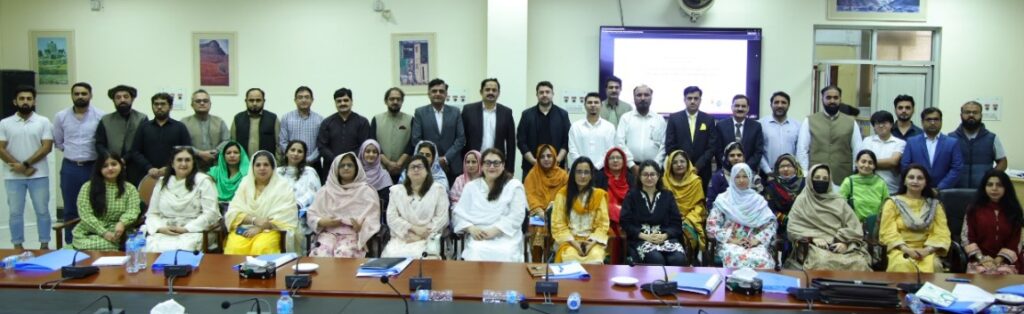
Attendees at the workshop “Leveraging EdTech to Support Learning Continuity in Climate Emergencies.” Photo credit: Nawaz Aslam.
In many flood responses in Pakistan, the focus has understandably been on immediate material losses and infrastructure recovery, with limited attention to sustaining learning continuity through technology. These workshops were designed to address that gap by introducing participants to evidence from past emergencies — both in Pakistan and globally — and creating space to explore practical applications. The insights emerging from the scenario-based exercises demonstrate that when stakeholders engage with concrete examples and localised scenarios, the role of technology in supporting education becomes both visible and actionable. This blog highlights those insights, illustrating how such engagements can shift thinking from reactive responses towards more proactive, technology-enabled preparedness.
The workshop at a glance
Two in-person workshops were held in Islamabad and Karachi on 9 October 2025 and 11 March 2026, respectively, bringing together 61 participants from the government, international civil society organisations, and education sector partners across 26 organisations. Through facilitated discussions, collaborative exercises, and peer learning, participants examined the role that technology can play in supporting learning continuity while grappling with access, communication, inclusion, and contextual relevance.
Rather than promoting specific technologies, the training encouraged participants to critically reflect on technologies and digital resources existing in crisis-affected contexts, and to strengthen and integrate these into broader preparedness and response efforts through coordinated planning, cross-sector collaboration, and sustainable financing.
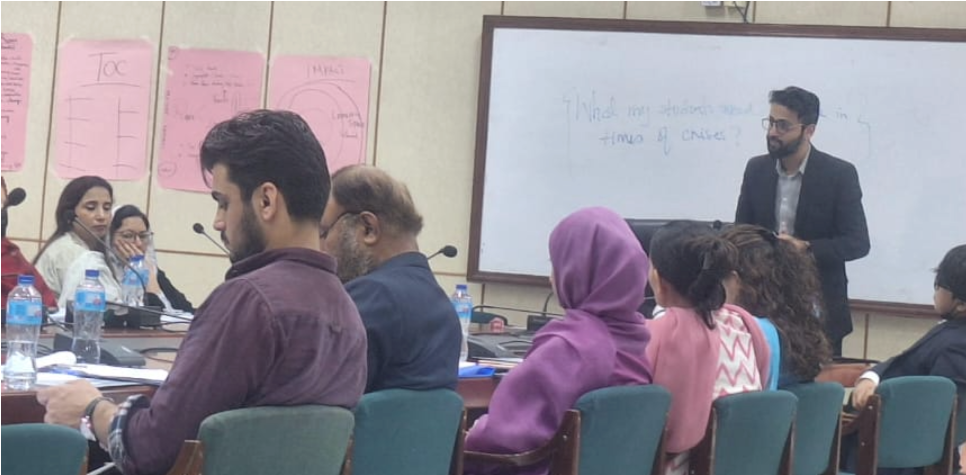
Nawaz Aslam presenting on behalf of EdTech Hub at the workshop “Leveraging EdTech to Support Learning Continuity in Climate Emergencies.”
Training at a glance
Learning through real-world scenarios
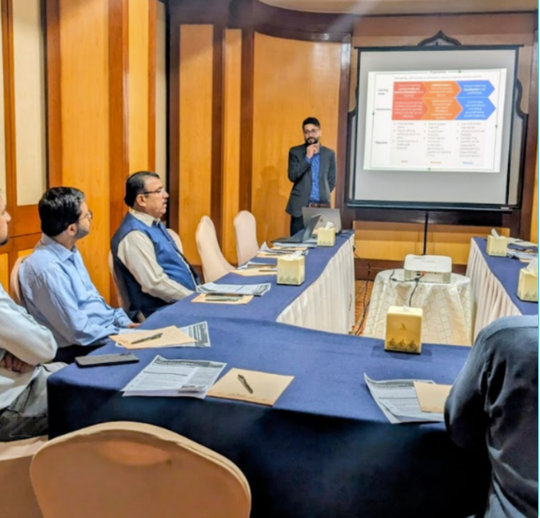
Nawaz Aslam presenting on behalf of EdTech Hub at the workshop.
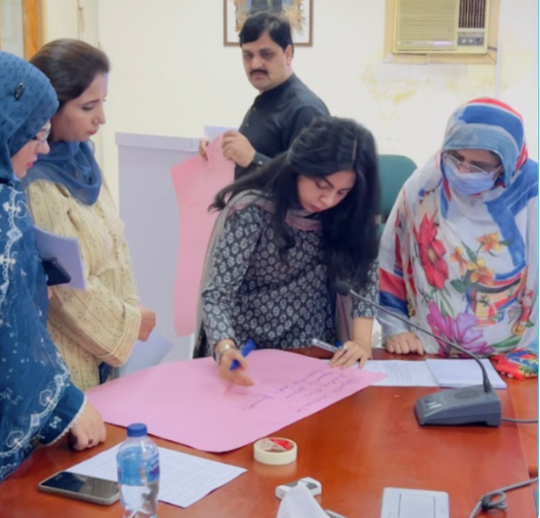
Participants engage in a hands-on activity as part of the workshop.
The training challenged participants to move beyond theory and work through a series of realistic flood-response scenarios that mirrored the challenges education systems face before, during, and after a crisis to surface what it would take to support learning continuity at each stage. The workshop structured its scenarios across the four phases of a disaster, with each scenario highlighting the specific challenges associated with that phase. Discussions were then facilitated around key themes and focus areas relevant to each phase, allowing participants to engage with context-specific considerations systematically.
What emerged from the discussions
Across all four scenarios, five themes consistently surfaced — each one mapped onto a different stage of the emergency cycle above.
- Preparedness is as important as the response. Participants agreed that EdTech can help “improve readiness for possible situations” and that risk assessment needs to be built into the processes well before a crisis occurs. Early data collection on students and teachers likely to be affected, identifying and mapping alternative learning spaces, and preparing offline-ready content emerged as essential preparatory steps rather than emergency afterthoughts.
- Technology must be adapted to local realities. Discussions emphasised designing around variable connectivity and electricity access, rather than assuming either is reliably available. Offline content, pre-loaded devices, and mobile resource units that can travel between locations were favoured over solutions that depend on a constant internet connection. Where digital access can’t be assumed, low-tech channels such as community announcements and door-to-door outreach were identified as necessary complements to any tech-based approach.
- Existing systems should be strengthened before new solutions are deployed. Participants showed a clear preference for building on current institutional capacity rather than introducing parallel structures, which often create confusion over ownership and accountability when multiple teams are involved. This extended to a recognition that tool adoption depends more on educator buy-in and confidence than on the availability of technology alone.
- Effective learning continuity requires cross-sectoral coordination. Participants recognised the need for coordination across government departments, international organisations, on-the-ground development partners, and community structures — with clear lines of responsibility seen as essential for sustained collaboration.
- Equity and inclusion need to be central throughout the emergency cycle. This means designing access models that don’t assume every household can provide individual devices to children or stay connected to the internet at all times and layering multiple communication channels, rather than relying on any single method. These approaches were expected by stakeholders to help ensure affected communities stay informed and supported regardless of their access to technology.
Voices from the training
We learned how to use EdTech in emergency situations. We now feel much more capable because we understand the sequence of how technology can be helpful during such disaster conditions.”
– Sajjad Gallhu, Assistant Director in Sindh Education Foundation
From today’s session, we learned a lot. We learned how we can use different types of strategies in different contexts, especially the use of AI and EdTech solutions.”
– Syeda Khanum, Assistant Director of the Training Unit, Sindh Education Foundation
Reflections at a glance
Learning continuity starts before a crisis
Preparedness planning is often overlooked, yet it is essential for ensuring learners and teachers remain connected to education during a crisis.
Technology alone is not the solution
Effective EdTech is context-specific. Learning gains depend on learners, teachers, communities, content, infrastructure, and the education system working together.
Existing system resources matter
A well-coordinated governance system that spans provincial and district levels, paired with tested offline and online digital learning modalities that work efficiently, is more effective than deploying new technology.
Inclusion must be intentional
Connectivity, electricity, disability, gender, and geographic barriers must be considered from the outset.
Partnerships drive sustainability
Long-term success requires coordination across government, communities, development partners, and education actors.
Explore the training package
To support wider learning and adaptation, the complete training package is being made available for education practitioners, sector partners, and organisations working to strengthen learning in response to climate emergencies.
Training presentation deck
Policy brief with a phase-wise breakdown of insights and recommendations
The annex of the policy brief contains a list of technology-enabled interventions in Pakistan that can be repurposed for climate emergency contexts
Research on the feasibility and scalability of EdTech in response to climate emergencies
Looking ahead
As climate-related disruptions continue to challenge education systems, ensuring learning continuity will require preparedness, stakeholder collaboration, and the adaptation of context-appropriate solutions. This process requires a deep understanding of contextual needs, capacity needs, and budgetary availability. To better understand what it takes to develop and adapt EdTech for emergencies, stakeholders can refer to the forthcoming guidance document by EdTech Hub EdTech in Emergencies: A Guidance Document for Education Specialists. This document explores key areas for effective EdTech in crisis settings: 1) sound pedagogy, 2) sourcing, building, and maintaining technology, 3) ensuring equity and inclusion, 4) sustaining EdTech through financing, cost-effectiveness, affordability, and feasibility, and 5) adaptive monitoring, evaluation, and learning across EiE response phases.
As a next step, EdTech Hub is working with key stakeholders in Pakistan, including the Education Sector Working Group, to continue translating evidence into action to build a more resilient education system. In addition to ongoing training on using EdTech for emergencies. Through our AI Observatory, in partnership with the Pakistan Institute of Education, we actively collaborate to support the use of EdTech to address learning loss and foundational literacy and numeracy. Connect with nawaz.aslam@edtechhub.org for more information.
EdTech Hub and the authors would like to thank Pakistan’s Education Sector Working Group, co-led by Save the Children and UNICEF, for collaborating with the Hub on training workshops that help support learning continuity in response to Pakistan’s climate emergencies.
This work was made possible by the support of UK International Development.