

Overview
As global emergencies and crises continue to disrupt education systems and force millions of children out of school, there is growing recognition that governments must play a leading role in coordinating effective education responses. Ukraine offers a compelling example of how strong government leadership can help sustain learning continuity during conflict through the rapid development and implementation of a national digital education strategy. This overview explores the lessons emerging from Ukraine’s experience and why government leadership remains critical in emergency education contexts.
Context
When Russia launched its full-scale invasion of Ukraine in February 2022, more than 5.7 million school-aged children faced sudden, severe disruption to their education. What followed was not simply a story of crisis management. It was also a demonstration of what becomes possible when a government has invested in the right foundations before a shock arrives.
Ukraine’s experience offers an instructive picture of ministry-led crisis response, one that holds real lessons for education systems worldwide, while being clear-eyed about the specific conditions that made it possible.
Foundations Built Before the Crisis
Ukraine’s ability to sustain learning under conflict owed a great deal to decisions made years earlier. From 2016, the New Ukrainian Schools (NUS) reform had been building digital readiness into the system.

The Ministry of Digital Transformation was established in 2019, and a dedicated Directorate for Digital Transformation within the Ministry of Education and Science (MoES) was staffed and functioning by August 2021.
The COVID-19 pandemic, which forced school closures from March 2020, provided an important, if unwelcome, stress test. Working with civil society organisation Osvitoria, the MoES built the All-Ukrainian School Online (AUSO) platform from near scratch, delivering lessons via TV and YouTube within weeks and rolling out teacher training through national professional development marathons. Sign-language interpreted lessons were made available from the outset. By December 2020, AUSO had launched as a full e-learning platform, registering nearly five million visits in its first month.
COVID also revealed where the system fell short: connectivity gaps in rural areas, uneven digital skills among teachers, and households without devices. That knowledge proved as valuable as the platforms themselves.
When the invasion began, the MoES, particularly through the Digital Transformation Unit, had institutional structures, a functioning platform, and a clearer picture of the gaps it needed to address.
It wasn’t a one-off project. There was an actual unit in the ministry, staffed and functioning before the war. That changed everything when the crisis hit.”
– UN agency interviewee
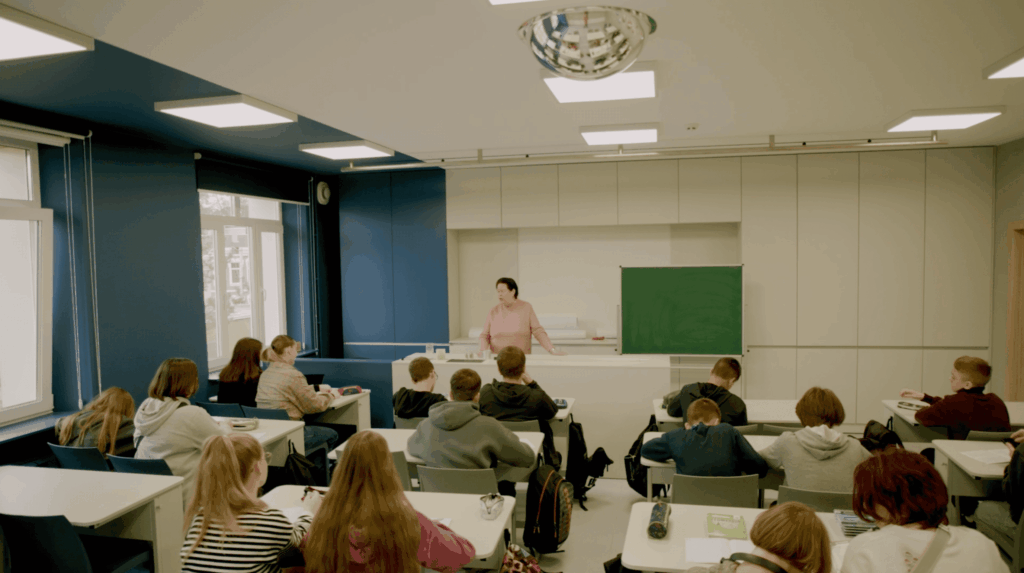
“A teacher in Ukraine teaching a class.” Image credit: Osvitoria.
Coordinating a Complex Response
Ukraine’s crisis response was characterised by deliberate government coordination at a moment when dozens of international agencies, donors, and NGOs were entering the education space simultaneously. The risk of fragmentation was real. The MoES moved to reduce it.
Partners were directed to work explicitly with AUSO and other government-led digital platforms, rather than build parallel systems. The MoES set minimum standards for Digital Learning Centres before humanitarian partners rolled them out on the ground. Device distribution was coordinated through a government-led coalition, the Device Coalition, launched in January 2024, bringing together UNESCO, UNICEF, Save the Children, the Olena Zelenska Foundation, Google, and HP under a single framework, with distribution tracked through official school systems and public dashboards.
The ministry also treated emergency investments as an opportunity to advance reforms already under way: consolidating the national education management information system, expanding hybrid learning infrastructure, and building teacher digital capacity at scale. Emergency response and system building ran in parallel rather than in sequence.
This degree of coordination was not without its difficulties. The MoES entered the crisis largely unfamiliar with humanitarian architecture, for example cluster coordination, proposal windows, and donor results frameworks. Early on, processes were slow and roles were unclear. But the ministry adapted. Rather than simply deferring to international agencies, it pushed back — advocating for faster approvals, closer alignment with national plans, and changes to procedures that did not fit the pace of an active crisis.
They had no idea of the whole humanitarian architecture, now they’re taking over it and will take full responsibility of coordination after the transition.”
– Education Cluster coordinator, reflecting on progress in 2025
What the Evidence Shows, and Where Gaps Remain
Ukraine’s digital education response has reached a significant scale. But the evidence is also honest about what the challenges felt.
The 2022 PISA results, lower than in 2018 , reflect the combined impact of COVID-19 and ongoing conflict, and underline the scale of the challenge facing the system. As UNICEF Representative Munir Mammadzadeh noted, the COVID-19 pandemic and the proceeding war have made it harder for Ukrainian children to succeed in school, leaving effects that will be felt long-term (Institution of Educational Analytics, 2023).
A 2024 national monitoring study of Ukrainian language learning (Ministry of Education and Science of Ukraine & Ukrainian Center for Educational Quality Assessment, 2024) found that learning outcomes did not vary significantly between fully remote and face-to-face delivery, though children in hybrid learning performed marginally worse. The analysis also found meaningful differences by gender, urban or rural location, and device type, with students using tablets performing better than those relying only on mobile phones. These findings point to the complexity of equity in crisis education responses: going digital does not automatically reduce disadvantage, and it can sometimes widen it.
Inclusion gaps proved particularly persistent. Around 40% of communities lacked the means to organise learning for children with special educational needs. Teaching assistants lost contact with students with disabilities, caregivers were left without adequate guidance, and teachers managed mixed-ability remote classes without specialist support. These are challenges that digital tools alone are not equipped to solve.
Teacher wellbeing also emerged as a critical factor. Around 90% of Ukrainian teachers reported worsening psychological wellbeing in early response snapshots. Global evidence consistently links teacher wellbeing to student outcomes, and Ukraine’s experience reinforces the case for treating teacher support as a systemic priority — not an afterthought.
What Other Systems Can Take From This
Ukraine’s response was shaped by conditions that are not universally present: years of prior reform, strong EU alignment, significant political will, and a level of international funding and trust that is rarely available to crisis-affected countries in the Global South. The gap between Ukraine’s context and that of many other conflict-affected systems is real and worth acknowledging honestly, not to dismiss the lessons, but to be clear about the work required to replicate them.
That said, several lessons are broadly applicable.
Pre-crisis investment is irreplaceable
Ukraine could scale its response because the platforms, structures, and institutional roles already existed. Building these during a crisis is possible, but much harder and slower.
Government coordination reduces fragmentation, but requires real capacity
Directing partners through national systems produced coherence. But it demanded significant institutional capacity, consistent political will, and donors willing to adapt. Ministries that understand humanitarian architecture can maintain policy control while channelling international resources toward national priorities. That fluency is better acquired before a crisis than during one.
Inclusion must be designed in from the start
The children hardest to reach were also those least served by distance learning. Equity gaps tend to widen when systems shift rapidly to digital delivery. Closing them requires offline options, assistive technologies, ring-fenced budgets, and clear accountability.
Accountability and flexibility can coexist
Dashboards and education management information systems maintained transparency without slowing delivery. Building these mechanisms and the trust around them before a crisis makes them far more effective when one arrives.
Crisis-responsive policy adjustment keeps policy connected to changing realities
Ukraine’s response did not rely only on one-time emergency rules. As needs became clearer, MoES adjusted delivery through feedback from data systems, partner coordination, and implementation experience. Device distribution moved through coordinated mechanisms such as the Device Coalition, supported by dashboards and monitoring tools. Crisis response often requires decision-making under uncertainty; therefore, policy must remain adjustable and structured around feedback loops that allow the government to revise delivery rules, target support, and reduce emerging burdens as evidence becomes clearer.
Ukraine’s experience does not offer a universal model. But it is an honest account of what becomes possible when the government leads, invests early, and builds the trust to do so. For education systems thinking about resilience, there is much here to learn from — and much to sit with.
Acknowledgements
Thank you to colleagues from the Ministry of Education in Ukraine, as well as development partners who were involved and contributed to the broader research.
Thank you to EdTech Hub colleagues Jazzlyne Gunawan, Aprilia Chrisani, Kate Radford, and Sophie Longley for supporting the development of this research finding summary.
We gratefully acknowledge Osvitoria for providing images to support this overview.
Resilient by Design: Ukraine’s EdTech Emergency Response.
Citation: Bhatt, M. and Radford, K. (2025), https://doi.org/10.53832/edtechhub.1122.