

About
Our process includes four steps to help you articulate your vision for leveraging AI for solving education challenges, and then defining how you might experiment in the real world to get there. Work through them in a team, or use them to pressure-test thinking you’ve already done. The output is a hypothesis you can actually test that brings your vision to life. Click on a step to get started.
Everyone’s asking what AI can do for education. The harder question is what you’re trying to change — and for whom.”
An Adaptive Process, Not a Prescription
These four steps aren’t a checklist — but prompts for reflection. They are meant as practical steps which adapt to your own personal vision and challenges related to education and AI. Take them step-by-step, and focus on what’s most pressing for you.
What does success look like for you?
Before reaching for tools or strategies, it helps to name what you are working toward, and for whom. A vision worth working towards names an audience and connects AI use cases to a concrete change in their experience.
What role might AI play to support those you work with? What does the experience of learners and teachers look like in an AI-supported education system?
Write 1 to 2 sentences describing what you want AI to help you achieve.
“I want the teachers I work with to leverage AI tools to gain efficiencies, and ultimately improve their instruction.”
Notice how this vision names a specific audience (teachers) and links AI to a concrete outcome (efficiency leading to better instruction).
What is actually in the way?
The more grounded your barriers, the sharper your hypothesis will be. Consider challenges across different dimensions rather than jumping to solutions too quickly.
What is keeping you from achieving that vision? Identify 2 to 4 core challenges in your context, considering: people and capacity, resources and access, systems and structures, connectivity and infrastructure, awareness and motivation.
For the vision: teachers using AI for efficiency and better instruction.
Locating yourself in the landscape
The AI Observatory framework describes AI integration through three horizons and six levers. These are not sequential stages, but a map. Most systems are working across multiple horizons at once. The question is where your specific intervention sits and how you might learn from others on a similar path.
In which horizon is your AI vision focused on ? Which levers can you pull to help realise your vision? Use the framework below to sharpen your thinking and map your vision to a lever and horizon.
Upgrade
Doing existing things better: faster admin, streamlined assessment, personalised content within familiar structures.
Disrupt
AI becomes embedded, shifting roles, practices and assumptions about how education works.
Transform
Rethinking education from the ground up: new purposes, structures and models for a world shaped by AI.
Enable learners
Empower teachers
Streamline bureaucracy
Align partnerships
Context-driven solutions
Renew purpose of learning
Turning your thinking into something testable
A good hypothesis connects an action to a change, and is specific enough that you would know whether it worked. The if-then format helps with this.
How will you know if your vision is feasible? Define it with an if-then statement and then interrogate: is it specific enough to test? Does it link an action to a measurable change? Does it reflect the realities you are working in?
If [action that addresses a barrier], then [expected outcome for learners or teachers].
teachers co-design AI tools built for them, with support from their school leadership…
they will develop AI literacy, gain confidence in those tools, and ultimately improve instruction.
This hypothesis addresses a specific barrier (low AI literacy and adoption), proposes a concrete action (co-design with leadership support), and points toward measurable outcomes (literacy, confidence, instruction quality).
What We’re Testing — and Why We’re Sharing It
After identifying our hypotheses the AI Observatory & Action Lab runs its own Action Lab Initiatives to test them in the real world. These help us learn about specific use cases, and share insights with our community of education decision makers.
Teachers-in-the-Lead
If teachers are meaningfully engaged in shaping how AI is designed and used, we believe we can unlock more learning.
Explore the sandboxesMinistry of Education AI Challenge
If ministries are equipped to use AI effectively, they can deliver more with less, faster.
Explore the challenge
What’s Your Hypothesis?
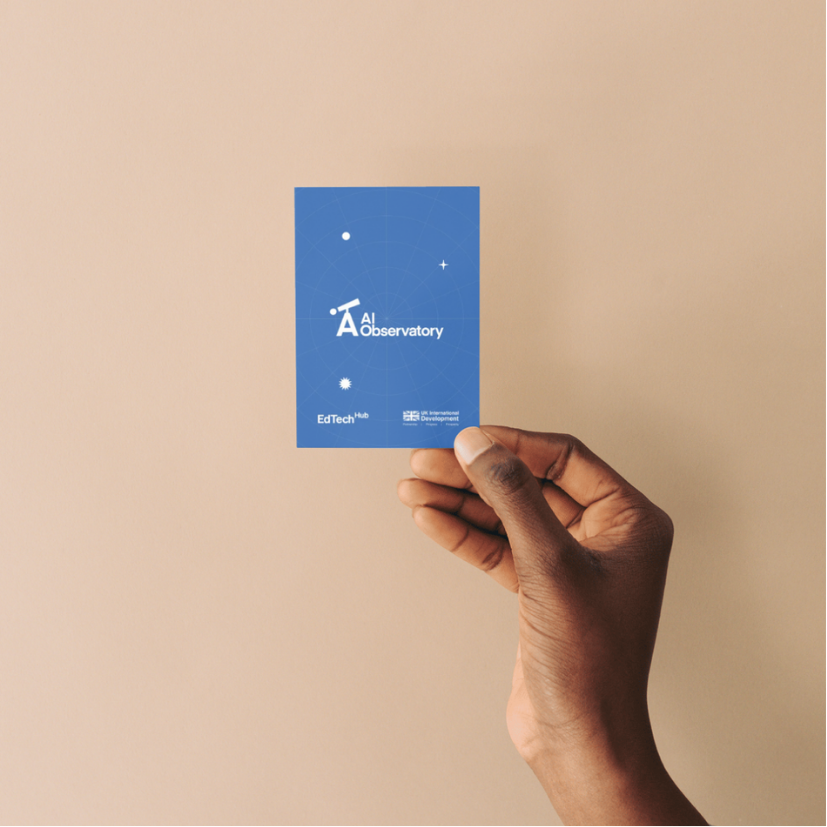
To help you build your hypothesis, we have created a deck of cards that guides you through a series of questions and examples. These act as a navigation guide: helping you define your vision, overcome key barriers, and shape your hypothesis more clearly.
See the Framework in Action
You have named your vision, mapped your barriers, and built a hypothesis. Now see how others are working across the same terrain. Our curated resource library organises evidence from across the world around the six levers — so you can find what is most relevant to your context.

Connect With Us
We’d like to know what you’re working on. If you’ve worked through these steps and arrived somewhere, share it with the AI Observatory network.