
Most strategic planning starts from what’s already happening — from the priorities, pressures, and problems already on the table. But a lot of what will shape education in the future isn’t on anyone’s radar yet. A “Field Trip to the Future” is one way we create space to explore what’s coming, and what it might mean for learners, education institutions, and the people who lead them. This post is about how we do that work, and why it matters for people making decisions in education.
What Is a Field Trip to the Future?
A Field Trip to the Future is an immersive experience. You step into a scenario set several years from now and engage with it as if it’s already here. Two practices sit behind it: strategic foresight tells us which futures are worth paying attention to. Design fiction makes those futures something a group can engage with.
Strategic foresight starts with horizon scanning, a technique that we use to detect early signs of potentially important developments from across low- and middle-income countries. From there we synthesise patterns into a trends report, which feeds scenario planning: developing a picture of what 2031 could look like. Backcasting takes that picture and works backward to ask what education needs today.
Design fiction builds an immersive experience set in a possible future, creating artefacts from the future (objects, characters, audio, video, documents) that participants can interact with directly. The aim is to suspend disbelief about the future for long enough that people can engage with it as if it were real. A scenario in a report describes a future to you. Design fiction puts you inside one, as a participant with a stake. The term was coined by Bruce Sterling in his 2005 book Shaping Things, with Julian Bleecker’s 2009 essay establishing it as a research method.
We’ve run field trips like this with teams working in programmes, strategy, and policy. Participants have consistently described them as engaging and energising and said they help with strategic planning and policy thinking.
EdTech Hub’s First Field Trip
In March 2026, we took 50 education decision-makers on an exclusive field trip to the future to ask, “what is education for in a world where AI does most of the work?” The invitation read:
Do you recognise this tension? On one side, enormous pressure to equip learners with AI skills: close the gap, build workforce readiness, stay competitive. On the other, a growing sense that the future we’re preparing them for is changing faster than we can keep up with.
Most conversations about AI in education stay on the first side of that tension. This immersive workshop sits with the second. Step into a future scenario where AI has transformed the way we live and work, and explore: What is education for in a world where AI does most of the work?”
The trip followed the method described above. Using our Signal Library, a curated selection of developments relevant to AI and education in low- and middle-income countries, we’ve been tracking signs that this question is more pressing than it might appear. We synthesised these signals into our trends report on Learners in the Age of AI and built a 2031 scenario from there.
To bring this future scenario to life, participants closed their eyes for a guided audio “time travel” experience and opened them to meet an AI from 2031, who introduced them to four fictional personas living different versions of the question. After watching vlogs from each persona, participants discussed what they’d seen, then each named one core competency young people would need to thrive in that world.
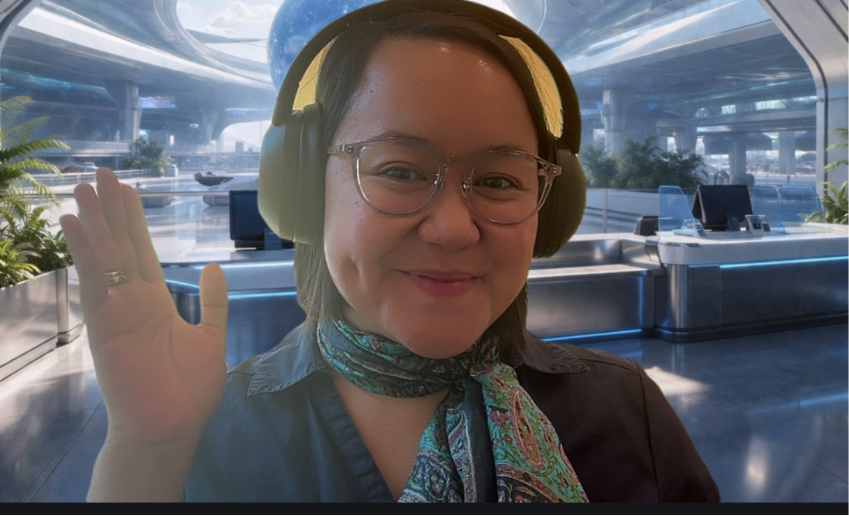
Meet Maria from the Philippines. One of four personas from this future.
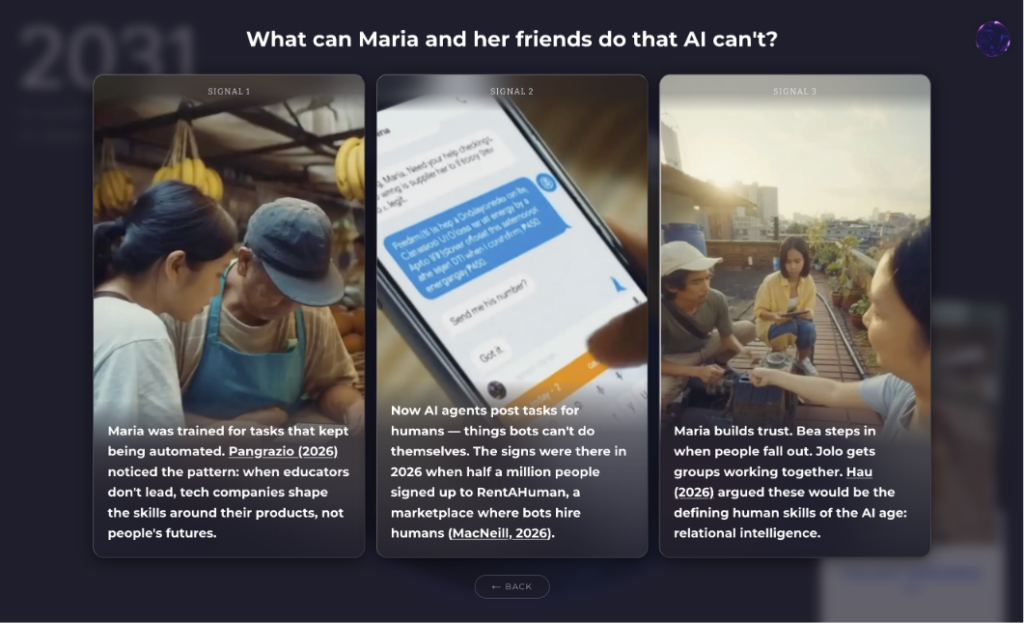
Maria’s story was grounded in real signals from our Signal Library, as you can see below.
What the Field Trip Surfaced
Each participant named one core competency young people would need to thrive in that world. The most common: interpersonal skills, critical thinking, empathy, and independent thinking. The discussion that produced those answers raised some interesting questions.
On measurement: how do you assess the things participants said matter most? One participant put it directly: “Numeracy and literacy is easy to measure, but when it comes to skills like empathy how do you measure that?” Current systems may be undervaluing exactly the competencies the future of work most rewards.”
On time and curriculum space: “We need to give more space and time to assess and hone interpersonal skills.” If empathy and critical thinking are the qualities young people will need most, what gets dropped to make room for them?”
On framing skills: “A question I have is, are these skills that exist currently and we just need a new name for them in our school system?” Another participant pointed to the language itself as the signal. Judgement is increasingly being called “human judgement”, because AI has taken over part of what the word used to cover.”
In the post-event survey, 94% of participants said the trip increased their confidence in engaging in conversations about AI and asking better questions of implementers. The same proportion said they came away clearer on the challenges to mitigate when using AI in education.
One participant, Swarna Surya, wrote her own piece inspired by the workshop, on the STEM-versus-humanities question and how the field trip reframed it.
And on how the experience landed, here’s some feedback participants shared with us:
The format was novel and exciting.”
“Helped me think about these scenarios more concretely.”
“Opened up a rich discussion.”
“This conversation has given me hope.”
Why This Kind of Work Matters
Makes room for what’s not on the agenda yet
Most traditional planning time goes to what’s already urgent. A field trip carves out a few hours of a different kind of attention. Time to sit with what’s emerging before it becomes pressing, and space to ask bigger questions than the one in front of you this week.
Given that time, you tend to notice things the current planning cycle doesn’t make room for. Igor Ansoff, the strategist who first developed this idea, called it “managing strategic surprise”: catching weak signals of what’s coming while there’s still room to act on them.
Stress-test your strategies against possibilities, not predictions
“Will this happen?” is usually the hardest question in the room. If you wait until you can answer it, you’ve missed the window.
A field trip changes the question to “if something like this happens, what would we need to have in place?” That’s a more useful question for people making decisions with incomplete information. The UK Government Office for Science makes the case: “By considering alternative plausible future worlds… we can develop more resilient policies with a better chance of delivering the outcomes we are seeking, whatever the future holds.”
Identify the choices that shape the outcomes you want
Much of how the future turns out isn’t fixed yet. As the UK Government Office for Science puts it,
The future is open to change; it can be shaped to achieve better outcomes.”
Stepping into a specific future helps you work out whether it’s one you’d want to build toward or push against. That informs what you do today. You can sort the decisions in front of you into ones that build toward the future you’d want, and ones that don’t.
What’s Next
We’ll be running more of these over the coming year. If you want to talk about running one inside your organisation, get in touch. We are also now opening up the next Field Trip to the Future to the public, sign up here for announcements.
EdTech Hub’s AI Observatory is made possible with the support of the UK’s Foreign, Commonwealth and Development Office.