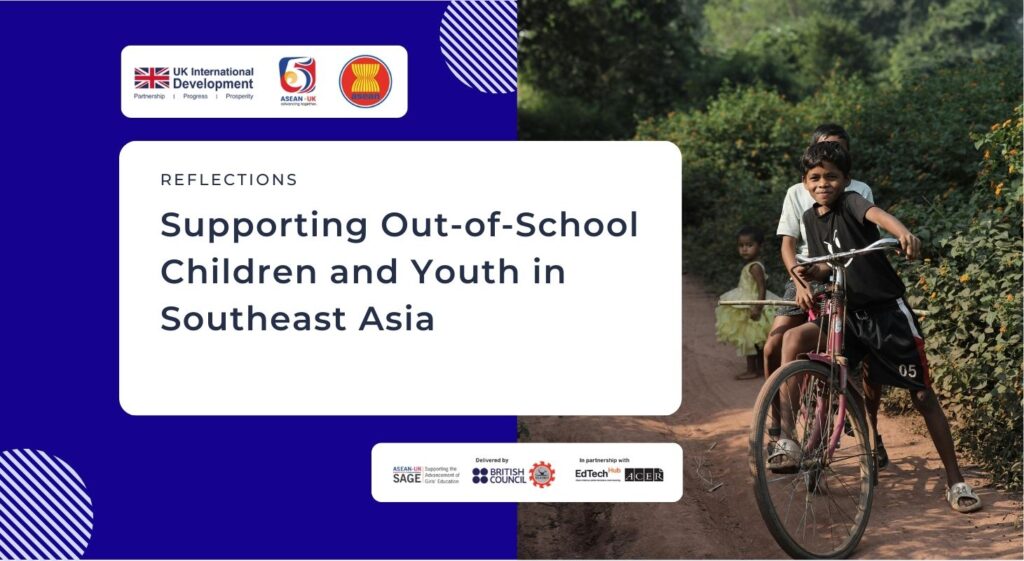
Across Southeast Asia, millions of children and youth remain out of school, facing barriers from poverty, mobility, and inequality. EdTech Hub’s work explores how digital learning can expand access, uncovering lessons on flexible education, human support, and evidence-driven strategies that help these learners stay engaged, complete schooling, and thrive.
Out-of-school children and youth (OOSCY) have long represented a persistent and complex challenge across Southeast Asia. This challenge reflects deep-rooted inequalities related to poverty, mobility, disability, gender, and access to education. The Association of Southeast Asian Nations (ASEAN) Declaration on Strengthening Education for OOSCY was adopted in 2016, formally recognising the significant number of children and youth excluded from education and affirming education as a fundamental human right. Through the declaration, ASEAN committed to prioritising inclusive, equitable, and accessible education policies and coordinated regional action to ensure OOSCY learners have meaningful access to quality education.
Lessons Learnt
Drawing on EdTech Hub’s research and programme experience since 2024, several lessons have emerged on what it takes to effectively support OOSCY learners across diverse Southeast Asian contexts.
1. Success is Hard Won and Requires Sustained Support
Re-engaging OOSCY learners and supporting them through to completion is complex and resource intensive. Learners often face competing demands such as paid work and family responsibilities, meaning that progress and graduation reflect persistence and resilience rather than a straightforward return to schooling. This underscores the need for programmes that are patient, adequately resourced, and designed for long-term engagement rather than quick wins.
As Kimlay Leav, an education programme officer with UNESCO Cambodia working on the Basic Education Equivalency Programme (BEEP) said in a 2025 key informant interview:
If it were easy to engage and support OOSCY, then we wouldn’t need programmes like ours”.
- Flexibility through EdTech is central to success
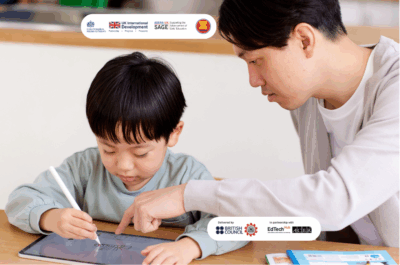
Digital and mobile-based learning modalities play a critical role by allowing learners to access education in ways that fit around their daily lives. The ability to engage with learning at flexible times and through widely available devices, such as mobile phones, helps remove structural barriers that previously excluded many OOSCY from formal education pathways. Put simply, without EdTech and digital learning pathways, many OOSCY would not be able to access or complete education.
- Human and community support remain essential
While technology expands access, it is most effective when paired with strong relational support. Successful OOSCY programmes combine digital delivery with mentoring, regular check-ins, and community-based follow-up, recognising that sustained human contact and trust are vital for maintaining motivation and re-engaging learners when participation drops. Many programme participants have discussed following up with OOSCY learners at their homes or simply checking in with a text message. This human touch is immeasurable in its impact.
- Evidence can take many forms
Evaluating the impact of EdTech-enabled programmes involves collecting quantitative data on concrete elements like enrolment, learning, and completion among OOSCY learners remains a critical objective. However, the reflections, insights, and lived experiences of OOSCY learners, teachers, families, and programme staff also constitute an essential form of evidence, offering precious insight into what works, what challenges persist, and how OOSCY learners can be better supported in the future. When conducting research to inform policy and programme design, it has been important to recognise that evidence takes multiple forms and that guidance grounded in the voices of those directly supporting OOSCY learners across Southeast Asia provides indispensable context and practical relevance.
- Supporting OOSCY learners matters, everywhere
Beyond numbers and programmes, supporting OOSCY reflects a moral imperative. As John Dewey wrote in The School and Society: “what the best and wisest parent wants for his own child, that must the community want for all of its children”. In a time when nations are becoming increasingly inward looking, and funding for global education has been drastically reduced, it is more important than ever to remember why this work matters. Through supporting OOSCY learners in Southeast Asia, the whole world community benefits. At its core, this work affirms a shared moral commitment to one another and a belief that the promise of education should not stop at borders, circumstance, or birth.
What’s Next
Looking ahead, regional momentum has been further strengthened by the Langkawi Joint Statement on ASEAN Out-of-School Children and Youth (OOSCY). Adopted in June 2025, it establishes a clear mandate for the strategic use of education technology and digital learning to address persistent educational exclusion across Southeast Asia. The statement recognises that OOSCY challenges are intensified by poverty, inequality, climate-related shocks, conflict, and the long-term impacts of the COVID-19 pandemic, and affirms that traditional delivery models alone are insufficient to ensure equitable access to learning. It positions flexible, technology-enabled, and inclusive approaches as essential to expanding access for marginalised learners and to building resilient, future-ready education systems aligned with regional and global commitments.
In response, the statement calls for the strategic use of EdTech and digital learning tools, including digital platforms, data systems, and alternative learning pathways, to identify learners at risk of exclusion, support early intervention, and enable more personalised and flexible learning opportunities for OOSCY. It also highlights the importance of enabling conditions such as capacity building, ethical data governance, partnerships with the private sector and civil society, and regional collaboration to support evidence-based decision-making. EdTech Hub will follow this guidance by remaining attentive to emerging evidence and regional dialogue, contributing learning where possible, and supporting continued reflection on how technology-enabled approaches can equitably reach and sustain OOSCY learners across diverse contexts.