Tanzania’s national Teacher Continuous Professional Development (TCPD, or ‘MEWAKA’ in Kiswahili) Learning Management System (LMS) is increasingly becoming an integral component of nationwide teacher support.
What is the LMS?
The LMS is owned and managed by Tanzania Institute of Education. It serves as a repository of interactive, TCPD content which can be accessed by teachers across Tanzania via a smartphone, tablet or computer to support teachers’ self-paced learning and school- or cluster-based Communities of Learning. This allows teachers to build their skills in response to the subject or pedagogical challenges they face, rather than treating TCPD as a homogenous experience.
With support from EdTech Hub and The Gates Foundation, the LMS was improved to better meet the needs of teachers: search engine optimisation was enhanced to make it easier to find online, the interface was made more user-friendly for teachers, and a wider range of TCPD content made available. At the same time, Tanzania Institute of Education partnered with Vodacom to zero-rate the platform (meaning Vodacom customers can access it for free), and UNESCO have committed to expanding the platform to serve secondary school teachers.
As momentum builds for tech-enhanced TCPD in Tanzania there is an acute need to make sure no teacher is left behind — particularly those in schools with no network or electricity.
This became a focus of our Regional Teachers Initiative for Africa project: We sought to address the issue of how to provide access to the national TCPD LMS to teachers in schools with no network coverage in Tanzania, by testing the use of local servers (Raspberry Pis) loaded with the LMS in 8 ‘hard-to-reach’ schools in Dodoma and Kigoma (a further four, more urban schools are testing a zero-rating LMS access pathway).
In this blog post, we reflect on lessons learned from the first year of implementation of this work. From sampling strategy and baseline data collection, to piloting and training delivery, the challenges encountered have surfaced important realities about working with these communities, with implications for all stakeholders.
(Spoiler alert: the solution is not to ignore them!)
Sample selection becomes its own project
When you want to work with a school that has no, or very poor network coverage, finding that school is difficult. You can’t make calls to confirm existing infrastructure, number of teachers, and other key demographic information needed to be sure the proposed schools meet the sampling criteria. In addition, centralised government data often isn’t up-to-date because of challenges in teacher retention in rural areas and ward-, district-, and regional education officers also facing the same challenges in contacting and reaching the schools.
The only way to confirm the requirements of the school is to physically go and visit. Given the location of such schools, this is then a time- and resource-intensive activity incurring significant budget (4×4 car hire, fuel costs, LoE, lodging, etc.).
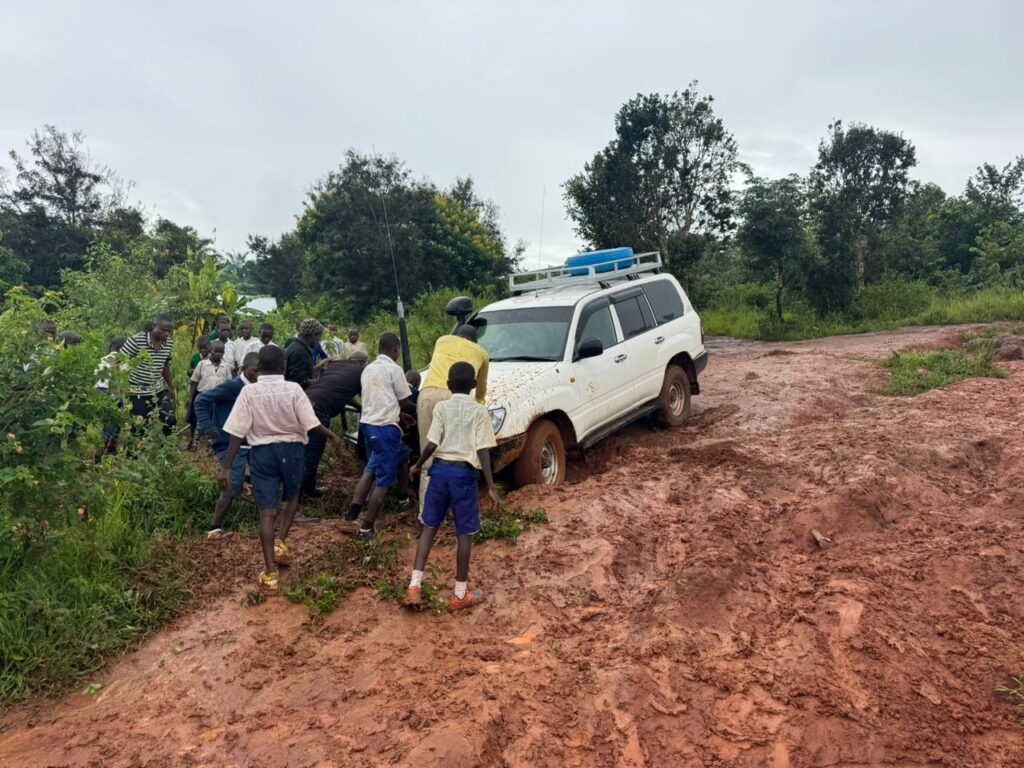
Even with these considerations taken care of, some of these schools are challenging to reach by 4×4, especially during the rainy season. The only time to visit is during the dry season, although this still depends on weather and road conditions.
Rural schools are increasingly at risk of climate shocks
Hard-to-reach schools are not only (or exclusively) far from main roads. They are also difficult to reach because of the poor quality of roads (or lack thereof).
A quick google-map consult can be deceiving: the distance in kilometers is often grossly inaccurate because impassable roads require extensive, winding detours. Think of the time before Google maps, and stopping every few kilometers to ask a local community member where the school is, we even had community members escorting us part of the way!
This is exacerbated by the fact that whether or not a road is passable is often determined by the weather. Communities were once well-positioned to advise on the best times to visit, taking into account the annual weather patterns.
However, climate change has not only made predicting the frequency and volume of rainfall at a local level increasingly difficult, it is also causing erosion. This means roads are not recovering from rainy seasons as they perhaps once did (see Tanzania Roads Fund and World Bank’s Tanzania Roads to Inclusion and Socioeconomic Opportunities (RISE) Project).
In the context of our work, this culminated in a major challenge with implications for budget and research validity.
In short, in the week between our research team undertaking baseline data collection and our intervention team heading to schools to deliver training and install Raspberry Pi (RPi) offline servers, the bridges connecting two of our sample schools with the wider region had collapsed due to heavy rainfall.
When we visited one school during the data collection stage, the Head of School and the Ward Education Officer advised us to complete our tasks as early as possible. They cautioned that if it rained while we were still at the school, we might not be able to return.”
– Researchers from Tanzania Institute of Education and Prime Minister’s Office, Regional Administration and Local Government.
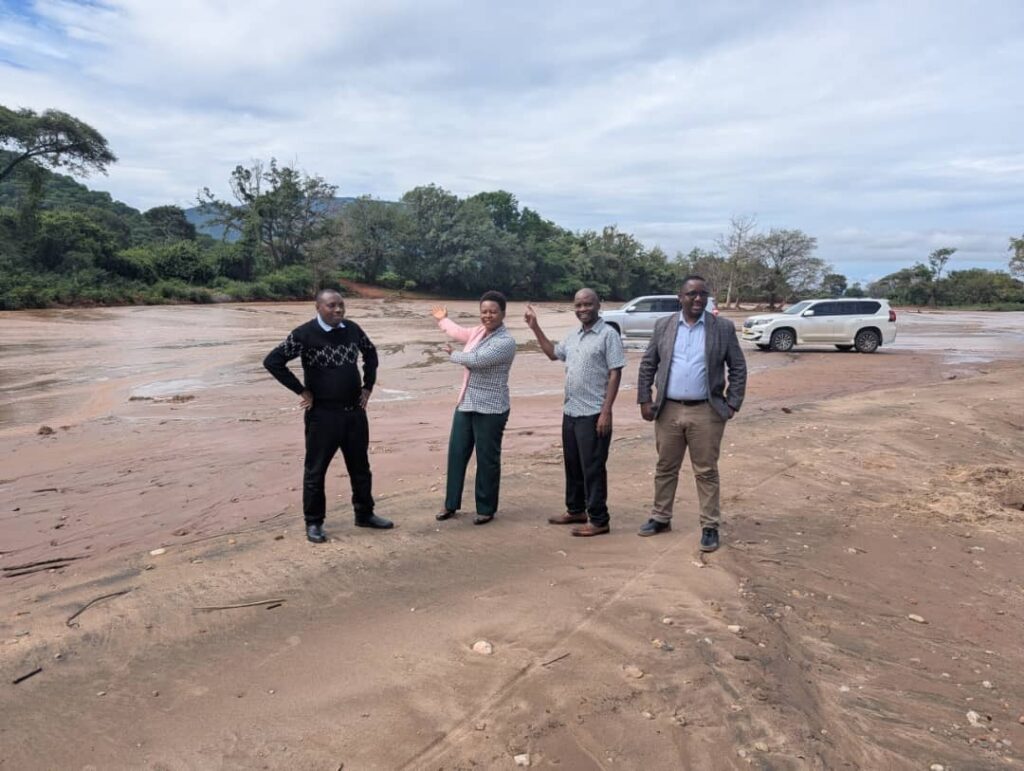
The Research Team, Jonathon Paskali, Vicky Mrosso, Philbert Komba and Joel Mhoja, prepare to cross a river to reach a school in Dodoma’s Mpwapwa district.
Ideally, we would have pivoted at this point to engage back-up schools in our intervention. But collecting data from back-up schools is necessarily costly (and hard-to-reach!), and we had also already collected baseline data from the two sampled schools in question. So, in this instance, budget constraints had meant back-up schools were only included in initial sampling and not in baseline data collection. Because of this, using back-up schools would now undermine the validity of our research to test our intervention. What’s more, we had to physically go to the schools to handover and install the RPis, so a remote alternative was not possible (notwithstanding network and power constraints).
Arguably, repairing infrastructure and restoring access is the responsibility of the regional and local authorities. But in LMICs, these authorities often lack the budget, resources and agility to provide rapid response, especially when the situation is not necessarily a humanitarian crisis.
This leaves rural communities to mobilise themselves for repairs (including any training needed) and sustain themselves in the meantime. And this leaves project teams like us no choice but to wait until it is safe and possible to return.
Regular, government Monitoring & Evaluation of “last mile” schools requires us to think differently
A common strategy to improve the sustainability of education interventions is to embed them within existing practices. There is growing emphasis on building capacity for the ‘middle tier’ of educational leadership and school quality assurance to monitor and support teachers in their professional development.
This strategy was part of our project design: we theorised that if we built awareness and skills of local Ward Education Officers to use the MEWAKA LMS, then they could promote it, help teachers login and use it as part of their regular school visits, ultimately providing pedagogical support when LMS use was regular and consistent.
What we overlooked was that schools which are hard to reach for research are also hard to reach for education officers. Even if they are motivated and equipped with the requisite knowledge and skills, they will encounter the very same challenges which have made it difficult for us to deliver TPD interventions – constrained by the same (and likely more significant) budget and time obstacles
“Monitoring and evaluation findings reveal that coordinators in these schools rarely conduct regular school visits. [the location of these schools] makes routine follow-up visits costly, time-consuming, and at times impossible, thereby limiting the consistency and quality of support provided to teachers,” – Joel Mhoja, TCPD Coordinator, PMO-RALG.
These challenges have direct implications for the effectiveness and sustainability of TCPD implementation and any other sustainable intervention in rural schools, and point to the need for additional, context-sensitive support.
Strategies identified by the Prime Minister’s Office to address the challenges of rural, government-led M&E include:
- Increased investment in facilitation of school visits (including transport support and logistical allowances) for TCPD-specific and general school monitoring
- Strengthening school-based leadership
- Offering innovative, mobile-based support could also help to improve school monitoring and quality assurance (taking into account network challenges)
Without such targeted support, there is a high risk that schools in hard-to-reach areas will continue to lag behind, thereby widening inequities.”
– Joel Mhoja, TCPD Coordinator, PMO-RALG.
Taken together, what are the recommendations?
For funders:
- Be prepared for budgets to appear lean on activities and high on costs; this is necessary to reach and engage these schools. Allocate enough funding and set realistic budgets to cover the high expenses of reaching remote schools.
- Be patient – if teachers are sick, it’s not always possible to go back the next day.
- Don’t expect to ‘pop in’ – reaching these communities takes a lot of planning, including being flexible with the weather so you may not be able to tack on a school visit to formal meetings.
For researchers:
- See existing data on topography, location, network coverage as stage one. Stage 2 is the in-person validation of this and it is necessary.
- Budget for back-up schools to be included in the study, so if your sample shrinks then you still have sufficient data for analysis.
- Allow more time for data collection since additional time is needed to reach such schools.
For implementers:
- Design interventions for rural inclusivity, exploring offline-first options for hard-to-reach schools.
- Implement flexible plans that adapt to local conditions such as poor infrastructure, weather, and limited staff.
- Invest in supporting local education officers to maintain and monitor interventions.