This is one of three blog posts exploring EdTech Hub’s recent SEND work, focused on how technology can help ensure learners with neurodevelopmental conditions have equitable access to education. Across the series, we draw on our primary research in Ghana and Malawi, alongside our cross-cutting work in implementation science and low-cost nudges.
Across Africa, education systems are turning to technology to help make education more inclusive. Digital tools can support screening, individualised education plans (IEPs), teacher supervision, and communication with families. But an important question remains: can digital tools truly improve support for learners with neurodevelopmental disabilities in low-resource settings?
Evidence from Ghana and Malawi suggests that the answer is yes, but only if technology is introduced as part of a wider system of support.
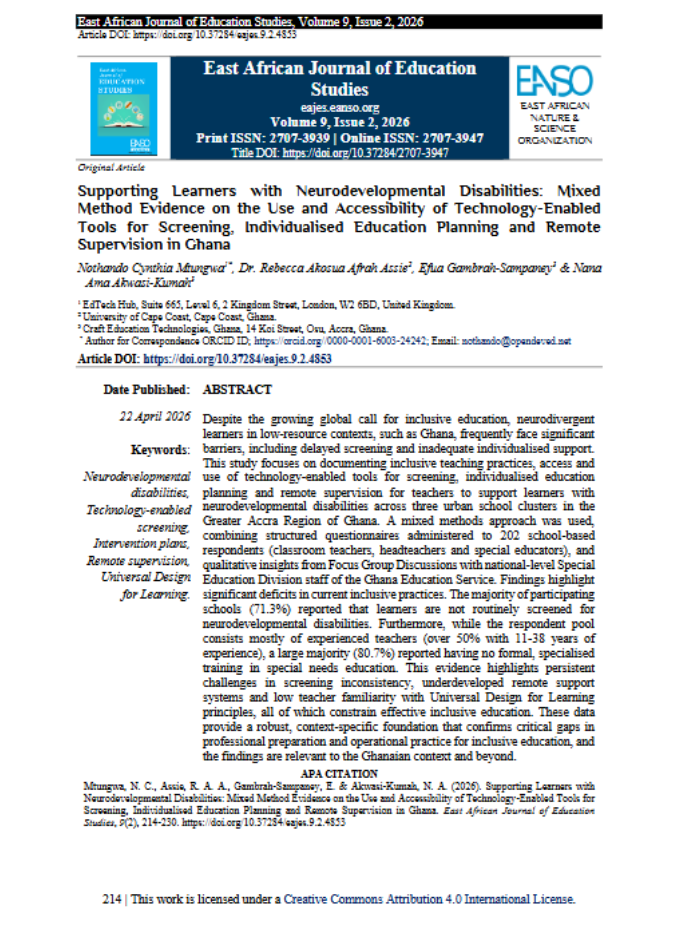
EdTech Hub’s recent study in Ghana with Craft Education, Supporting Learners with Neurodevelopmental Disabilities: Mixed Method Evidence on the Use and Accessibility of Technology-Enabled Tools for Screening, Individualised Education Planning and Remote Supervision in Ghana, explores how technology can support learners with neurodevelopmental disabilities.
Building on this research, EdTech Hub has begun collaboration in 2026 with Fount For Nations on an evaluation across six primary schools in Lilongwe and Salima districts in Malawi which presents a similar picture. In the baseline study, schools and teachers have shown a strong commitment to inclusive education, but gaps in staffing, infrastructure, digital systems, and coordination limit what they can deliver.
Taken together, these findings offer an important lesson for education systems across low- and middle-income countries (LMICs). The challenge is not simply getting technology into schools. It is creating the conditions that allow technology to make a lasting difference.
What the Ghana Study Found
The Ghana study examined the use and accessibility of technology-enabled tools for three key areas:
- screening learners with neurodevelopmental disabilities
- developing IEPs
- providing remote supervision and support for teachers and specialists.
The findings point to several opportunities. Digital screening tools could support earlier identification of learners who need additional support. Digital IEP systems can make education plans more structured and easier to update, while remote supervision helps specialists reach teachers in places where specialist services are limited.
Technology also contributed to improved communication. Teachers, caregivers, and professionals had a unified platform to share information more easily, helping to create a more connected approach to supporting learners.
However, the study also identified barriers that are familiar across many low-resource education systems. Access to devices and reliable internet remains limited, digital skills among educators vary, and paper-based systems continue to dominate many inclusive education processes.
The message is clear: having a digital tool is not the same as having a digital system. Without the infrastructure, skills, institutional support, and processes needed to use technology effectively, even promising tools may struggle to move beyond small-scale use.
Malawi’s Baseline Evaluation Tells a Similar Story
The 2026 Malawi baseline evaluation found many of the same opportunities and challenges.
There are strong foundations to build on. School leaders showed commitment to inclusive education, teachers expressed enthusiasm about adopting digital innovations, and schools demonstrated collaborative approaches to supporting learners. Caregivers were also actively involved in learner support.
These findings matter because they challenge a common assumption: that the main barrier to digital inclusion is resistance to change.
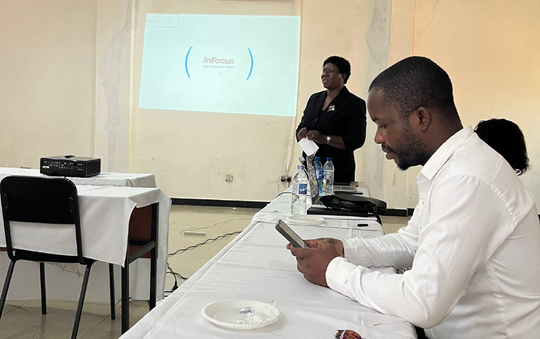
In the schools studied in Malawi, readiness was not the main problem. Capacity was. The evaluation found severe shortages of trained special needs education (SNE) teachers and specialists. A small number of professionals are often expected to support large numbers of learners, making it difficult to provide regular assessment, IEP support, and follow-up.
Paper-based systems also remain central to screening, IEP development, and reporting. This can make it harder to maintain records, track learner progress, and ensure that information follows a learner when support needs to continue across teachers, schools, or services.
Digital infrastructure presents another major barrier. Schools have limited access to devices, unreliable connectivity, and few established systems for technical support. In these conditions, asking teachers to adopt digital tools without first addressing the underlying infrastructure risks creating another burden rather than solving an existing problem.
The evaluation also highlighted gaps in collaboration between education and health services. Referral pathways were often informal, and health professionals were not consistently involved in IEP processes. Data systems were in place, but staffing and data-quality challenges limited how effectively they could support planning and decision-making.
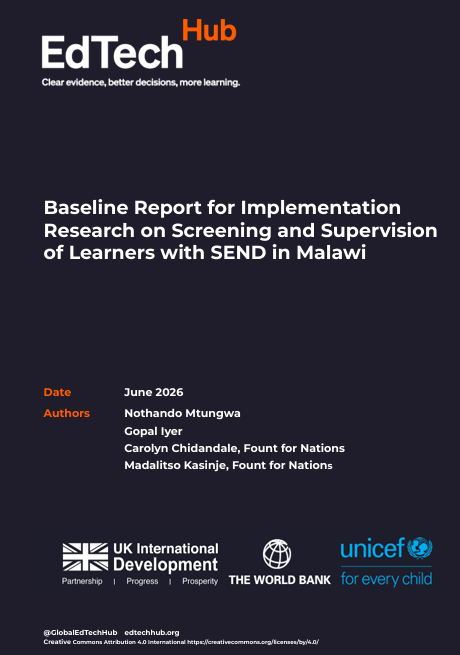
This baseline evaluation provides a comprehensive assessment of the current state of inclusive education across six primary schools in the Lilongwe and Salima districts of Malawi.
A Shared Lesson: Technology Alone Is Not Enough
When the Ghana and Malawi findings are considered together, a clear regional message emerges.
Educators and school leaders are not necessarily resistant to digital innovation. Digital tools can support screening, IEP management, remote supervision, communication, and data use. The larger barriers are often systemic rather than motivational.
This distinction is important. If the problem is framed simply as a lack of technology, the solution may be to provide more devices or introduce a new platform. But if the problem is understood as a systems challenge, the response looks different.
Technology needs people, infrastructure, processes, and institutions around it.
What Needs to Change?
1. Invest for SEND expertise in the workforce
Technology can extend the reach of specialists, but it cannot replace them.
2. Build the digital foundation
Digital inclusion starts with the basics: devices, electricity, connectivity, and technical support.
3. Move from paper to practical digital systems
Digitisation should not simply reproduce complicated paper processes on a screen. Systems need to be simple, accessible, locally relevant, and designed around the realities of teachers and schools.
4. Strengthen health and education collaboration
Digital systems could help connect health and education services, but only where clear roles, referral processes, and data-sharing arrangements are already in place.
5. Make data useful
Good data should help schools and districts identify learners who need support, track progress, plan resources, and make better decisions.
From Readiness to Real Change
The Ghana and Malawi evidence points to an encouraging conclusion: the appetite for change is already there.
Teachers want to support learners. School leaders are committed to inclusion. Caregivers are engaged. Digital tools offer new ways to connect people, improve records, extend specialist support, and strengthen decision-making.
The next step is to turn this readiness into sustainable change.
For governments and education partners, this means treating digital inclusion as a systems reform agenda rather than a technology project. It means investing in people alongside devices, strengthening infrastructure alongside platforms, and improving coordination alongside data systems.
The Deputy Director for Inclusive Education in Malawi’s Ministry of Education, Lucy Magagula, emphasised that the ultimate objective of the research should be to generate sufficient high-quality evidence to inform wider implementation and scale-up. She stated:
We would like to roll out & scale this, and scaling this means gathering quality evidence. Quality evidence means it is coming from each of the teachers.”
– Lucy Magagula, Deputy Director for Inclusive Education in Malawi’s Ministry of Education
For technology developers, it means designing tools with, rather than simply for teachers and education systems in low-resource settings. Tools need to work in contexts where connectivity may be unreliable, specialist support may be limited, and paper systems remain deeply embedded.
And for researchers and policymakers, it means continuing to ask not only whether a digital tool works, but what conditions are needed for it to work at scale and for the learners who need it most.
The Opportunity Ahead
Learners with neurodevelopmental disabilities including autism, intellectual disabilities, ADHD, and other conditions that affect learning, communication, behaviour, or development remain among the groups most likely to experience barriers to identification, participation, and appropriate educational support. Digital technology cannot solve all these challenges, but it can help address some of them.
Digital screening can support earlier identification. Electronic IEPs can strengthen continuity and accountability. Remote supervision can extend specialist support to schools that might otherwise have limited access to it. Better digital records can help education systems make more informed decisions about resources and learner support.
But Ghana and Malawi remind us that technology is only part of the solution.
The real opportunity is not simply to digitise existing systems. It is to use digital tools to build stronger, more connected, and more inclusive education systems.
The question, therefore, is no longer whether schools are ready for technology. In many cases, they are. The question is whether education systems are ready to give schools the people, infrastructure, systems, and support they need to turn that readiness into real change.
Want to explore the evidence further?
Read the Ghana study and the Malawi baseline evaluation to learn more about what it takes to use technology to strengthen inclusive education for learners with neurodevelopmental disabilities.
Baseline Report for Implementation Research on Screening and Supervision of Learners with SEND in Malawi
This baseline evaluation provides a comprehensive assessment of the current state of inclusive education across six primary schools in the Lilongwe and Salima districts of Malawi. The findings from…
Supporting Learners with Neurodevelopmental Disabilities: Mixed Method Evidence on the Use and Accessibility of Technology-Enabled Tools for Screening, Individualised Education Planning and Remote Supervision in Ghana
Despite the growing global call for inclusive education, neurodivergent learners in low-resource contexts, such as Ghana, frequently face significant barriers, including delayed screening and inadequate individualised support. This study focuses…