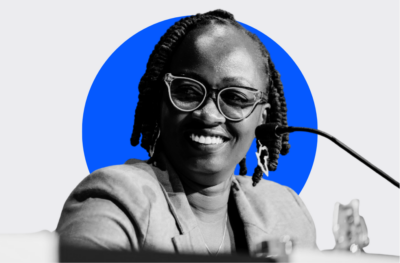

To mark the next stage of Signal Library, Guest Curators highlight three resources—two discovered through Signal Library, and one exclusive resource from their own work—with context on why it matters for navigating developments in AI and education across low- and middle-income countries. The Signal Library’s fifth Guest Curator is Dr Amy Jo Dowd, who recently joined Brink Foundation to lead its education research, supporting implementation teams and government partners to generate and use evidence to improve child development and education outcomes with equity.
About Our Guest Curator
Much of Amy Jo’s work asks who gets left behind: girls whose early learning advantage reverses in adolescence, and children who stay below basic proficiency even in programmes that work. Her curation brings that question to AI. If these tools mirror the biases of the systems around them, how do we stop more edtech from widening the gaps it is meant to close?
Amy Jo’s Curation — Breaking the Pattern: Gender, Bias and AI in Education
1. No, you can’t get your AI to ‘admit’ to being sexist, but it probably is anyway
Amy Jo’s curatorial note: “This article speaks to AI’s mirroring, reflection, and indeed replication of gender bias present in human systems. It offers examples of AI downgrading women’s titles, suggesting lesser life roles to girls, adding sexual aggression against female characters to novel drafts, and generating recommendation letters inserting emotional language for female names and skills-based language for male names.”
“If the ‘text prediction machine’ constantly adds (and at high speed) to the biased content available – how do we break the pattern?”
2. Reconceptualising the Digital Gender Divide, Accommodating New Forms of Virtual Gender-Based Violence
Amy Jo’s curatorial note: “This study lays out three aspects of the digital gender divide – access, use and empowerment – framing the importance of not just the hardware and skills to use ICT and AI, but also the quality of use in a meaningful, healthy, responsible, ethical, critical, and safe manner.”
“Reviewing cases of gender-based cyberviolence suffered by minors, the study shows how technology can: promote self-harm and suicide through exposure to harmful content, grooming, sexting and/or sextortion; enable digital sexual exploitation of underage girls through deepfakes or intimate AI-generated images; offer violent and hateful content in mass chats; and incite gender-based violence through video games.”
“The authors conclude that tech reproduces and perpetuates gender-based violence in the digital world and ends with a call for curbing the normalisation and adoption of sexist behaviour in both face-to-face and digital contexts via education, infusion of ethics and protection of rights.”
3. Girls’ schooling is important but insufficient to promote equality for boys and girls in childhood and across the life course
Amy Jo’s curatorial note: “This article uses global data across childhood, adolescence and adulthood to show that even though indicators of a healthy childhood and early schooling show girls ahead of boys in most low and middle income countries, by the end of secondary schooling in adolescence this has flipped and then worsens in adult labor market and leadership outcomes.”
“For education and tech alike, it is not enough to expand access and use – the norms around the system and the bias within the system must be addressed – so that all can benefit equally from more education, more opportunity as a result of more tech being well implemented. Without this attention, more education, more tech and more edtech are likely to benefit the well-being of the few and harm the most vulnerable.”
Want to be our next Guest Curator?
We’re building a growing network of voices shaping how education stakeholders understand AI developments. If you’re working on AI policy implementation, digital transformation, or education research in low- and middle-income countries, we’d love to hear from you.
Hear From More of Our Guests

Signal Library is Now Live: The First Ever Signals Database of Its Kind
Signal Library surfaces signals of change from credible research, evidence, news and blogs presenting a curated selection of the latest developments relevant to AI and education in low- and middle-income…
Extra Resources
Thanks to Amy Jo for her expert curation. You can learn more about Brink’s research and Amy Jo’s work here:
This fund backs research and implementation that tackle gender and learning together, at the transition to upper primary and secondary, where girls’ and boys’ outcomes begin to diverge. Amy Jo Dowd co-authored ‘The Big Picture’, the evidence scan underpinning it.
Co-authored by Amy Jo Dowd with Margaret Wawira, this blog opens a series on equity in foundational learning. It argues that even highly effective programmes leave many children behind, and that systems must be designed around those learning least.
uBoraBora is an implementation research fund launched in 2024 by the Brink Foundation in partnership with Laterite and seed funding from the Bill & Melinda Gates Foundation.
Taking its name from the Swahili words ‘quality’ and ‘better’, uBoraBora offers implementers of foundational literacy and numeracy programmes up to $100k in grant funding and technical assistance to adapt or improve their programme.
Amy Jo advised uBoraBora when it launched. Now, as Brink’s Education Research Director, she is bringing together the evidence it has generated on ongoing teacher support, the uptake of instructional materials, and the use of implementation research (IR) in foundational learning, so it can be shared more widely.
Funding EdTech Hub’s AI Observatory is made possible with the support of the UK International Development.